

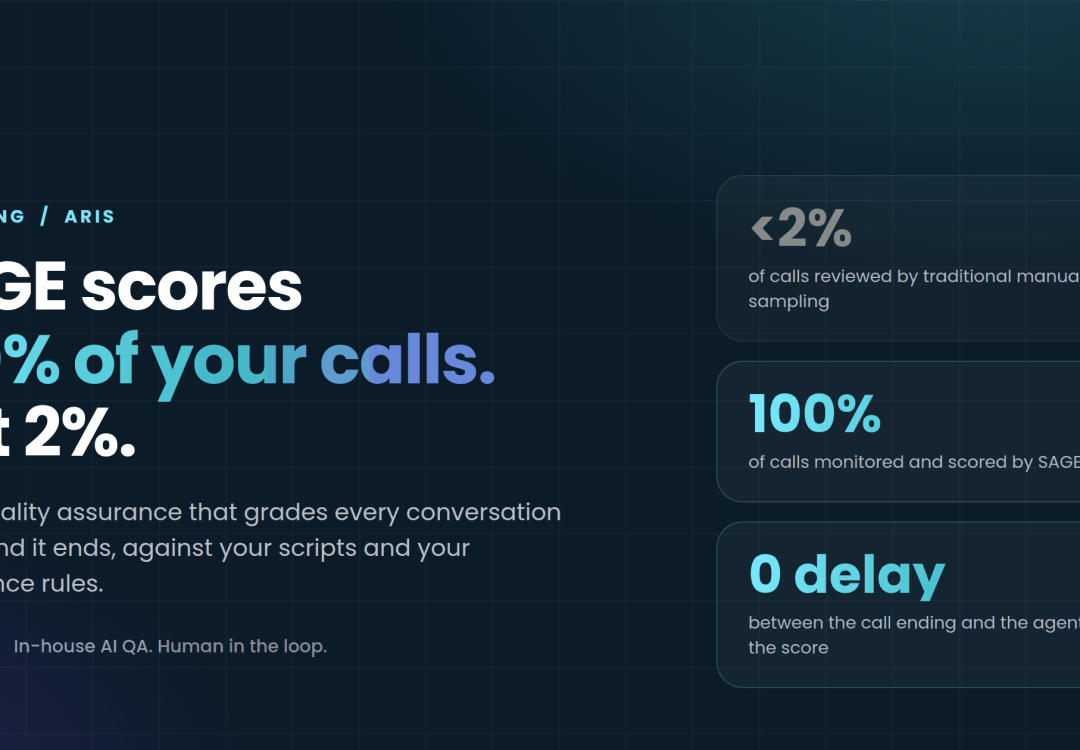
What Is SAGE? The AI Call Quality Assurance System That Scores 100% of Calls
By Arsalan Kamran, CEO and co-founder of AssistRing. Last updated: August 2026.
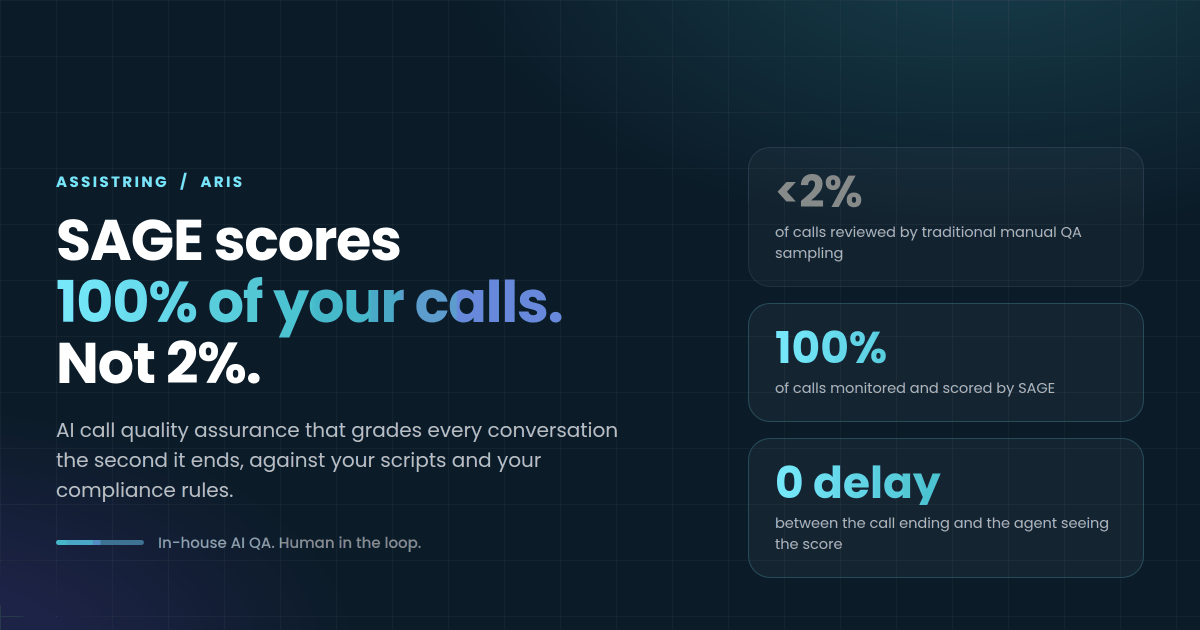
SAGE is AssistRing’s in-house AI quality assurance system. It scores every customer call the moment the call ends, against your scripts and your compliance rules, and puts the result in front of the agent and the client straight away. There is no sampling, no third-party licence on your invoice, and no waiting a week to find out that a call went wrong.
This guide covers the QA problem SAGE was built to solve, what it actually does, how it runs on a live campaign, how it compares with the way most contact centers still handle quality, and where it sits inside the wider ARIS system.
The 98% of calls nobody listens to
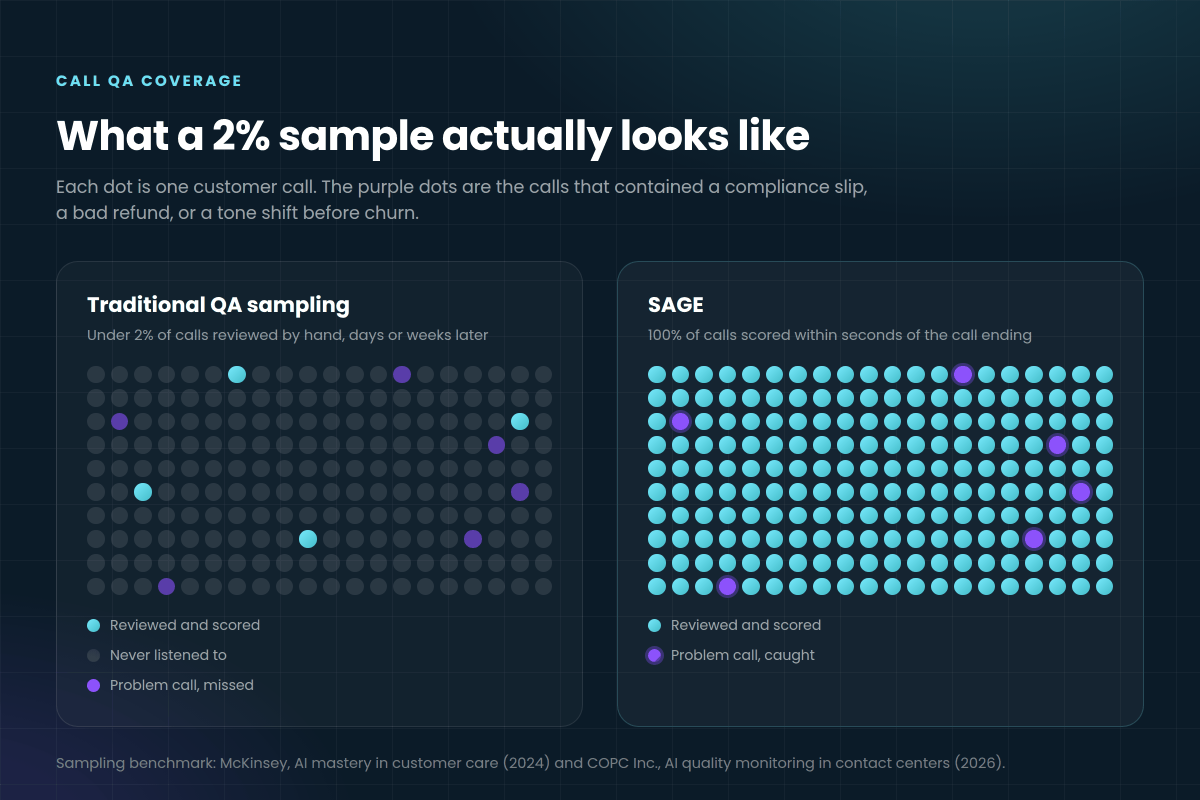
Most contact center QA runs on a sample. An analyst pulls a few calls per agent per month, scores them by hand against a rubric, and files a report. Research from McKinsey on AI in customer care and COPC’s 2026 work on contact center quality monitoring both put the typical manual review rate at under 2% of calls.
Read that as a buyer for a second. You are paying for quality assurance on roughly two calls in every hundred, and you are being asked to accept those two as a fair picture of the other ninety-eight.
They usually are not. The calls that hurt you are rare by definition. A compliance line skipped. A promise an agent was never authorised to make. A refund handled in a way that reads as dismissive. A tone shift three weeks before a customer quietly stops renewing. A 2% sample is close to built to miss those, and it misses them silently, which is the part that costs money.
There is a second problem, and it is harder to see because it hides inside the score itself. Human scoring drifts. The same call, graded by two analysts on two different Fridays, comes back as two different numbers. The same McKinsey and COPC research puts manual scoring accuracy at around 70%, against 90% or better for automated scoring. So the sample is small and the ruler bends.
We ran into all of this ourselves before we built anything. Our own QA team was doing careful work and still could not tell a client, with a straight face, what was happening on the calls nobody had listened to.
What SAGE does
It scores every call, not a sample
SAGE audits 100% of customer interactions on a campaign. Every call, every agent, every shift. Coverage stops being a budget decision, because the cost of scoring the hundredth call is the same as the cost of scoring the first.
That changes the kind of question a client can ask. Instead of “how did our agents do on the calls you reviewed,” it becomes “show me every call last month where the agent skipped the disclosure.” One of those questions has an answer.
The score arrives before the agent takes the next call
SAGE evaluates a call the moment it ends and returns the score immediately. Feedback delay drops to zero.
This matters more than it sounds like it should. Traditional QA feedback lands in a coaching session days or weeks later, when the agent no longer remembers the call, cannot picture the customer, and hears the whole thing as a verdict. Feedback delivered inside the same shift is something else entirely. The agent still remembers the conversation. They can fix the habit on the next call rather than in a review meeting next month.
The scoring is consistent because the scorer never has a bad day
SAGE applies the same rubric to every call at around 95% objective accuracy. No fatigue at 4pm on a Friday, no unconscious preference for the agents an analyst happens to like, no drift between one reviewer and another.
For an agent, this is the difference between QA that feels like surveillance and QA that feels like a measuring tape. For a client, it means a score in March and a score in September mean the same thing.
Agents and clients see the same screen
Agents have direct access to their own scores. So do clients. Nobody is waiting on a curated monthly PDF that has been through two rounds of internal polish.
Giving agents their own numbers is the part most QA programs get wrong. When people can see their score and the reason behind it, most of them correct without being told to. Our agents ramp up around 3x faster on SAGE than they did under the old review cycle, and it is not because anyone is coaching harder.
It runs on your rules, not a generic template
During onboarding, your scripts, SOPs, disclosures and compliance requirements are fed directly into SAGE. The system evaluates against your standard, not a generic call center rubric with your logo on it.
If your industry requires a specific disclosure at a specific point in the call, SAGE checks for it on every call. If your brand has a rule about how refunds get phrased, that becomes a scored criterion.
It works with the dialer you already use
SAGE connects to every major dialer and softphone on the market with no complex telephony project attached. You do not migrate your phone system to work with our QA, and there is no six-week integration phase before anyone sees a score.
There is no software licence line on your invoice
We built SAGE in-house, for our own operation. That is not a marketing detail, it is a pricing one. Most BPOs licence third-party QA software and pass the cost through to you, usually bundled somewhere you cannot see it. We do not have that cost, so you do not pay it. It is a straight contributor to how AssistRing delivers onshore-quality service at competitive offshore pricing.
How SAGE works on a live campaign
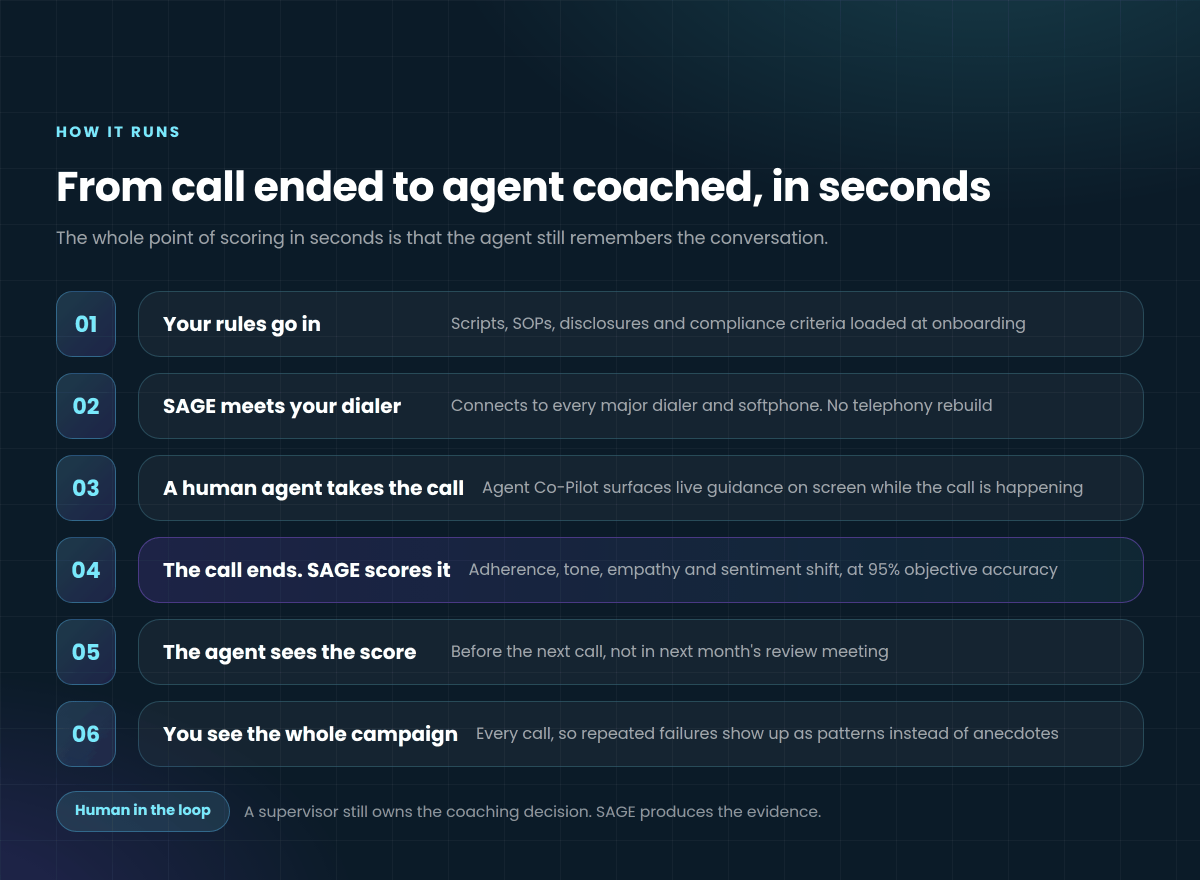
- Onboarding. Your scripts, SOPs, compliance rules and quality criteria are loaded into SAGE and turned into scored criteria.
- Connection. SAGE connects to your existing dialer or softphone. No telephony rebuild.
- The call happens. A human agent handles it. Agent Co-Pilot can surface script guidance on screen while the call is live.
- The call ends. SAGE evaluates the full interaction against your criteria, including tone, empathy, adherence and sentiment shift.
- Scoring. A score and the reasoning behind it are published within seconds.
- The agent sees it. Before the next call, not next month.
- You see it. Client-side visibility into scores across the campaign, not a sample of them.
- Patterns surface. Because coverage is total, repeated failure points show up as patterns rather than anecdotes. That is where most of the real operational value sits.
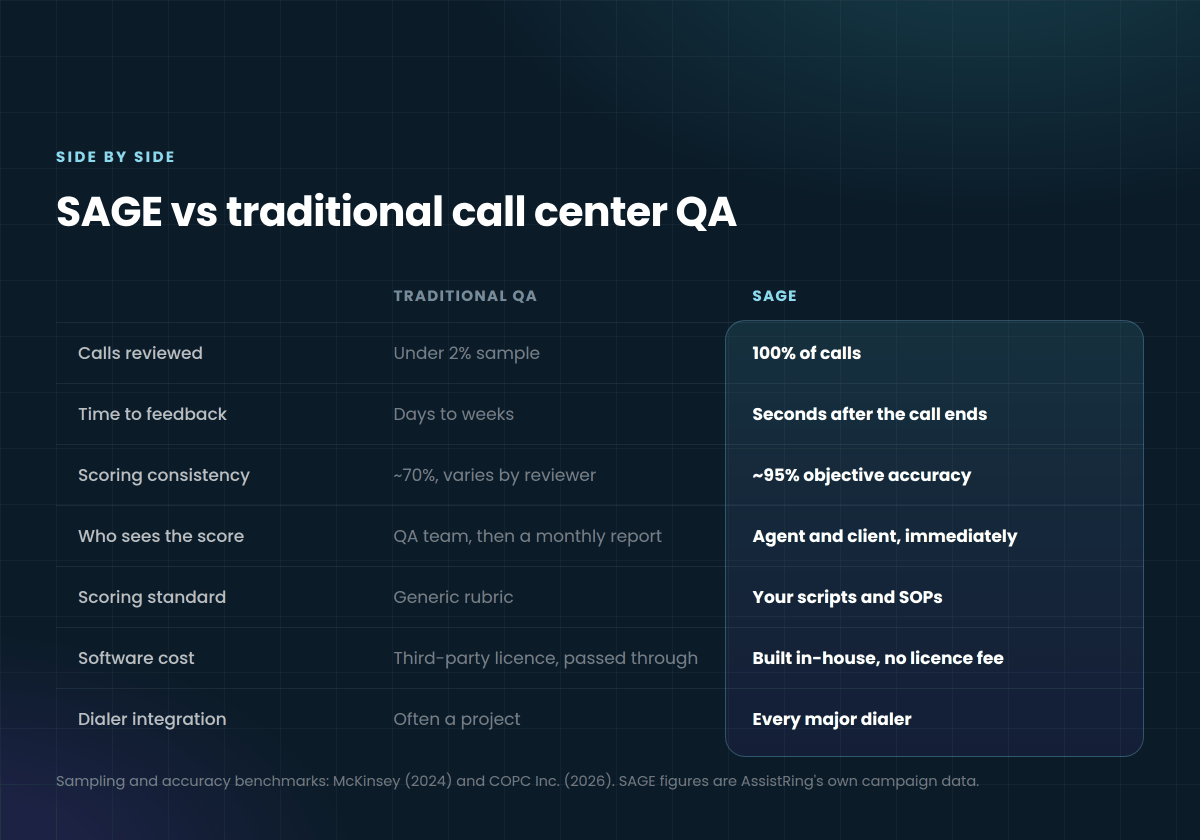
SAGE compared with traditional call center QA
Traditional QA |
SAGE |
|
|
Calls reviewed |
Under 2% sample |
100% of calls |
|
Time to feedback |
Days to weeks |
Seconds after the call ends |
|
Scoring consistency |
Around 70% accuracy, varies by reviewer |
Around 95% objective accuracy |
|
Who sees the score |
QA team, then a monthly client report |
Agent and client, immediately |
|
Scoring standard |
Generic rubric, lightly customised |
Your scripts and SOPs, loaded at onboarding |
|
Software cost |
Third-party licence, usually passed through |
Built in-house, no licence fee |
|
Dialer integration |
Often a project |
Works with every major dialer |
|
What it catches |
What happened to be in the sample |
The rare call that actually costs you money |
What changes when you score everything
These are AssistRing’s own figures from campaigns running on SAGE.
Metric |
Result |
|
Calls monitored and scored |
100% |
|
Objective scoring accuracy |
95% |
|
Feedback delay |
Zero |
|
Agent ramp-up speed |
3x faster |
|
Reduction in repeat callers |
45% |
|
Boost in first contact resolution |
40% |
|
Increase in customer satisfaction |
98% |
|
Reduction in operational overhead |
50% |
|
Agent productivity and retention |
50% higher |
The repeat-caller number is the one worth pausing on. A 45% drop in customers calling back about the same issue is not a QA statistic, it is a cost statistic. Every repeat call is a call you paid for twice and a customer whose patience you spent for nothing.
Where SAGE sits inside ARIS
SAGE is one module of ARIS, the AssistRing Intelligence System, which is the in-house AI layer running behind every AssistRing agent. The modules are built to work together.
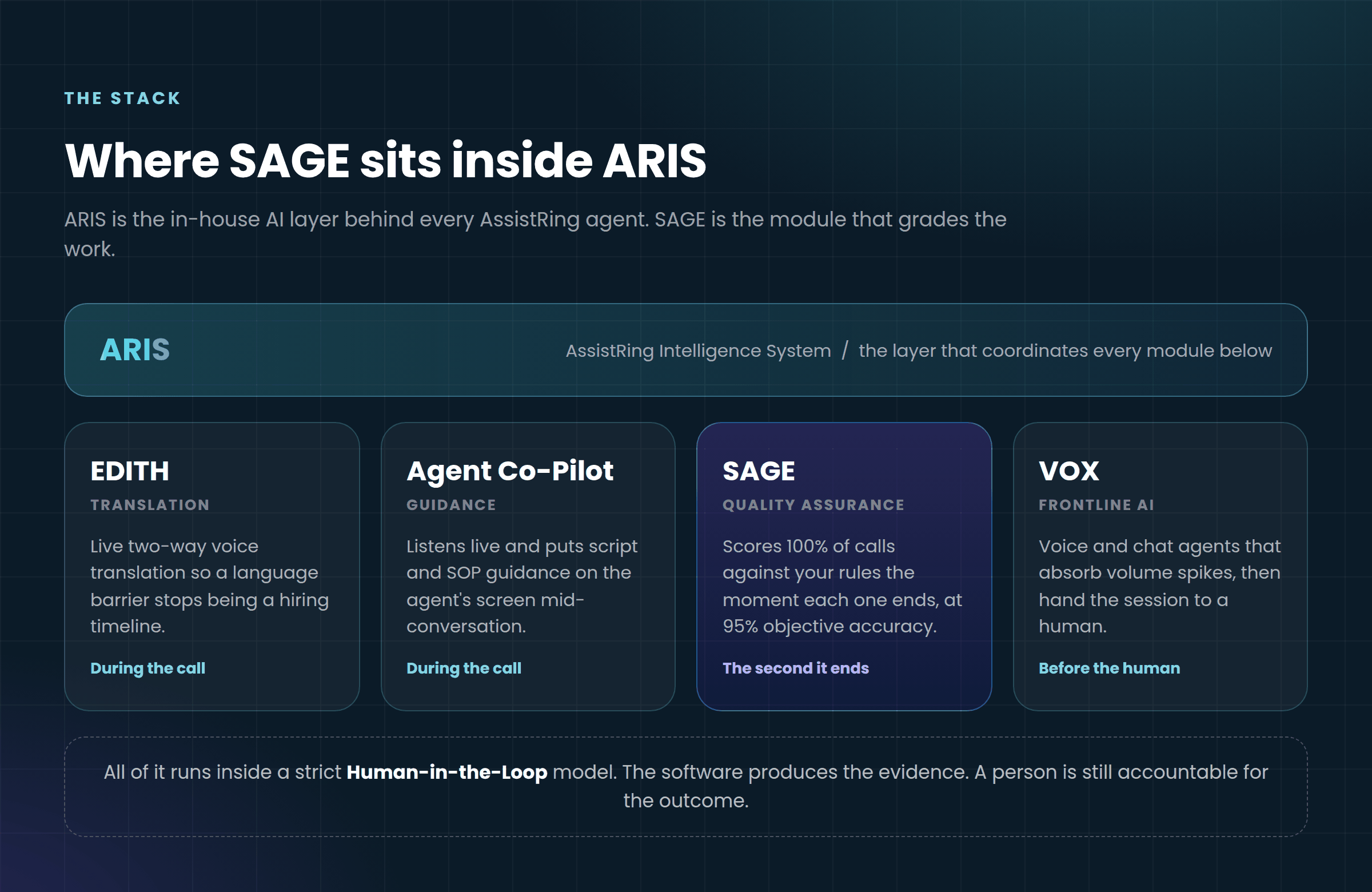
SAGE scores the call after it ends. Agent Co-Pilot runs during the call, listening live and putting script and SOP guidance on the agent’s screen while the conversation is still happening. EDITH translates live calls in both directions in real time, so a language barrier stops being a hiring timeline. VOX handles frontline voice and chat, absorbing volume spikes and tier-one queries, then handing the session to a live agent when a customer needs judgement or empathy.
All of it runs inside a strict Human-in-the-Loop model. SAGE does not decide whether an agent keeps their job. It produces the evidence a human supervisor uses to coach, and it produces that evidence for every call instead of two of them.
Industries running on SAGE
SAGE is in production across logistics, marketing, healthcare, finance, manufacturing, e-commerce and education. The rubric changes by industry, because a HIPAA-sensitive patient call and an e-commerce refund call fail in completely different ways. The mechanism does not change.
Security and compliance
AssistRing operates in compliance with PCI-DSS for payment handling, HIPAA for healthcare information, and GDPR for EU data protection, across both the physical facility in Karachi and the software layer.
The compliance argument for total coverage is straightforward. If a regulator asks whether a required disclosure was given on a specific call, “it was not in our sample” is not an answer. With SAGE, every call has been evaluated against the rule.
Five questions worth asking any BPO about quality
Useful whether or not you ever talk to us.
- What percentage of our calls will actually be scored? If the answer is a sample, ask what happens in the rest.
- How long between a call and the agent hearing about it? Anything measured in weeks is a report, not coaching.
- Who scores the calls, and how consistent are they across reviewers? Ask to see two analysts score the same call.
- Can our agents see their own scores? If not, QA is being used as a management tool rather than an improvement one.
- Are we paying for your QA software? Ask where the licence cost sits in the rate card.
The takeaway
SAGE is not a bot that replaces your QA team. It removes the sampling problem that made QA statistically weak in the first place, and it does that fast enough that the feedback still matters to the person who needs it. Every call scored, against your rules, in seconds, visible to the agent and to you, with a human still accountable for what happens next.
Ready to see it on your own calls?
Want to see what SAGE would show you about your own calls? Explore SAGE or talk to our team, and we will score a set of your recordings so you can compare the output against your current QA report.