Nearshore vs Offshore Call Centers: Cost, Coverage and Quality Compared
Last updated: September 14, 2026
Nearshore call centers sit one or two time zones from your business, usually in Latin America for a US company. Offshore call centers sit far outside your time zone, most often in South Asia or the Philippines. Nearshore buys you overlap and cultural proximity. Offshore buys you the deepest cost reduction and the largest talent pool. Neither one is automatically right, and the decision usually comes down to what your support volume actually looks like at 2 a.m.
What’s the difference between nearshore and offshore call centers?
A nearshore call center operates in a country close to your own, close enough that agents share most of the working day with your customers. For a US company that typically means Mexico, Colombia, or Costa Rica. An offshore call center operates on a different continent entirely, commonly Pakistan, the Philippines, or India, where labor costs are lower but the workday only partially overlaps with US or European business hours.
The distinction matters more than the map suggests. Time zone overlap changes how a manager coaches agents in real time. It changes whether a live escalation reaches someone awake and available. And it changes how naturally an agent can reference “this morning’s email” or “yesterday’s order” without a context gap.
How much does a nearshore call center cost compared to offshore?
Offshore staffing is consistently the cheaper of the two models, and nearshore sits in between offshore and a fully domestic team. The US Bureau of Labor Statistics put the median hourly wage for a customer service representative in the United States at $19.08, with a median annual wage of $39,680 (BLS Occupational Employment and Wage Statistics). That figure is the baseline every outsourcing decision gets measured against. A nearshore seat typically prices well under that US benchmark. An offshore seat typically prices under the nearshore rate again, because local cost of living and currency exchange both work in the buyer’s favor.
What the raw hourly rate hides is the cost of managing the gap. A cheaper seat that needs a night-shift supervisor, a translation layer, or a heavier QA sampling rate is not automatically the cheaper program once you add up the whole delivery stack. This is the number finance teams miss when they compare rate cards instead of total cost of ownership.
Which model wins on time zone alignment?
Nearshore wins here, decisively. A contact center in Bogotá or Guadalajara shares six to eight working hours with a company based in Dallas or Chicago. That overlap makes live coaching, same-day escalation, and real-time quality intervention straightforward. Offshore teams close that gap with shift design instead of geography: agents work overnight local hours to cover a US day shift, which works well but depends entirely on the vendor’s ability to staff and retain a night-shift workforce without burning through it.
“The time zone conversation is really a staffing conversation in disguise. Offshore only closes the gap if the vendor has built a real night-shift career path, not just a rotating roster nobody wants to stay on,” says Oscar Lausen, Co-Founder & COO of AssistRing, based in Hamburg.
Language, compliance and data handling
Multilingual coverage is where the two models diverge sharply. A nearshore hub in Latin America gives you Spanish and Portuguese fluency close to native, useful for a US company expanding into those markets. An offshore hub in South Asia gives you deep English fluency at scale plus, when the vendor has invested in it, real-time translation that removes the language barrier for European campaigns entirely. AssistRing’s own EDITH engine, for example, translates live calls in both directions across 100+ languages, which is a different answer to the language problem than hiring native speakers market by market.
Compliance follows a similar pattern: it is a vendor capability question, not a geography question. A BPO that operates to PCI-DSS, HIPAA, and GDPR standards can run that kind of program from Karachi as easily as from Guadalajara, provided client rules are actually built into the monitoring stack rather than left to agent memory.
5 factors that should decide the model
Before signing a location-based contract, weigh these in order:
Time zone overlap. How many live hours do agents need to share with your customers, or with your own QA team, for coaching and escalation to work?
Cost structure. Per-seat, per-minute, or dedicated FTE pricing changes the total more than the country on the map does.
Language and compliance needs. Multilingual coverage and PCI-DSS, HIPAA, or GDPR handling requirements narrow the realistic shortlist fast.
Quality control model. Real-time monitoring and a human-in-the-loop review layer matter more to outcomes than which country the seat sits in.
Scalability for spikes. Can the site flex from 20 to 100 seats for a seasonal or launch surge without a multi-week hiring cycle?
Nearshore vs offshore: side-by-side comparison
Dimension
Nearshore
Offshore
Typical hub for a US buyer
Mexico, Colombia, Costa Rica
Pakistan, Philippines, India
Time zone overlap
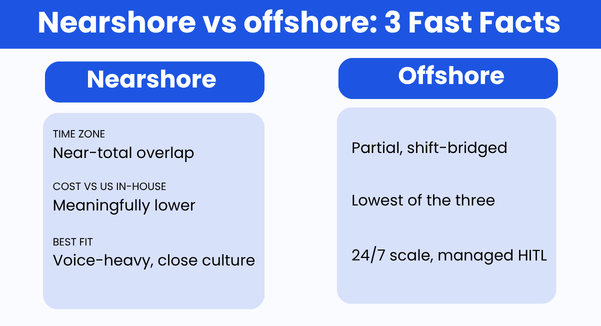
Near-total; live coaching is easy
Partial; bridged with shift design
Cost position vs. US in-house
Meaningfully lower
Lowest of the three models
Talent pool depth
Growing, still tight in hot markets
Large, English-fluent graduate pipelines
Best fit
Voice-heavy, culturally close support
24/7 scale with a managed human-in-the-loop model
Is offshore call center outsourcing still worth it in 2026?
Yes, for the right workload. Deloitte’s 2024 Global Outsourcing Survey found that 80% of surveyed leaders intend to maintain or increase their investment in third-party outsourcing (Deloitte Global Outsourcing Survey), and the same survey found 25% of executives already reporting reduced vendor costs or improved service quality through AI-enabled outsourcing. Offshore has not lost ground to nearshore; the two models are increasingly run in parallel, with offshore handling deep-night and back-office volume while nearshore or onshore teams cover the peak overlap hours.
The bigger shift is inside the delivery model, not between countries. Zendesk’s CX Trends 2026 report found that 73% of CX leaders believe AI will power all customer experience interactions in some form (Zendesk CX Trends 2026). That does not mean agents disappear from either model. It means the winning offshore and nearshore programs both pair AI with a human-in-the-loop layer instead of running either extreme: pure headcount with no automation, or pure automation with no escalation path.
How AssistRing bridges the gap
AssistRing runs delivery from Karachi, on-site rather than remote, with campaign strategy and client architecture directed from Hamburg. That structure puts European market judgment on the strategy side and a large, English-fluent, on-site delivery team on the execution side, which is one way to capture offshore economics without losing the coordination that nearshore buyers pay a premium for. Every seat runs inside AssistRing’s human-in-the-loop framework, with the ARIS system coordinating real-time quality monitoring, agent guidance, and (for non-English campaigns into Germany and Spain) live bidirectional translation through EDITH. VOX absorbs volume spikes on tier-1 queries and escalates anything that needs judgment to a live agent, so the automation layer supports the team rather than replacing it.
Occupancy, shrinkage, and first contact resolution still have to be measured the same way regardless of which hemisphere the seat sits in. A vendor’s location tells you about wage cost and working hours. It does not tell you whether the QA program actually catches a bad call before the customer does.
Frequently asked questions
What’s the difference between nearshore and offshore call centers?
Nearshore centers operate in a nearby country with heavy time zone overlap, typically Latin America for US buyers. Offshore centers operate farther away, commonly in South Asia or the Philippines, with lower costs but only partial overlap with a US or European workday.
Is nearshore outsourcing more expensive than offshore?
Usually, yes. Nearshore rates sit between offshore and fully domestic staffing. Offshore remains the lowest-cost option because of currency exchange and local cost-of-living differences, though the total cost gap narrows once shift premiums and management overhead are included.
Which is better for time zone alignment, nearshore or offshore?
Nearshore wins on time zone alignment by a wide margin. Latin American hubs typically share six to eight working hours with US companies, which makes live coaching and same-day escalation far simpler than coordinating across a 10-to-12-hour offshore gap.
Do offshore call centers speak English well enough for US customers?
Leading offshore hubs, particularly in the Philippines and Pakistan, have deep English-fluent graduate talent pools built specifically for US and UK voice support. Fluency varies by vendor and by individual agent, so ask for live call samples before signing, not just a language certification on paper.
Can you combine nearshore and offshore coverage in one contact center strategy?
Yes, and many mid-size and enterprise programs already do. A common split uses offshore capacity for overnight and back-office volume, with nearshore or onshore teams covering the peak hours where live coaching and cultural proximity matter most.
Nearshore call centers sit one or two time zones from your business, usually in Latin America for a US company. Offshore call centers sit far outside your time zone, most often in South Asia or the Philippines. Nearshore buys you overlap and cultural proximity. Offshore buys you the deepest cost reduction and the largest talent pool. Neither one is automatically right, and the decision usually comes down to what your support volume actually looks like at 2 a.m.
What’s the difference between nearshore and offshore call centers?
A nearshore call center operates in a country close to your own, close enough that agents share most of the working day with your customers. For a US company that typically means Mexico, Colombia, or Costa Rica. An offshore call center operates on a different continent entirely, commonly Pakistan, the Philippines, or India, where labor costs are lower but the workday only partially overlaps with US or European business hours.
The distinction matters more than the map suggests. Time zone overlap changes how a manager coaches agents in real time. It changes whether a live escalation reaches someone awake and available. And it changes how naturally an agent can reference “this morning’s email” or “yesterday’s order” without a context gap.
How much does a nearshore call center cost compared to offshore?
Offshore staffing is consistently the cheaper of the two models, and nearshore sits in between offshore and a fully domestic team. The US Bureau of Labor Statistics put the median hourly wage for a customer service representative in the United States at $19.08, with a median annual wage of $39,680 (BLS Occupational Employment and Wage Statistics). That figure is the baseline every outsourcing decision gets measured against. A nearshore seat typically prices well under that US benchmark. An offshore seat typically prices under the nearshore rate again, because local cost of living and currency exchange both work in the buyer’s favor.
What the raw hourly rate hides is the cost of managing the gap. A cheaper seat that needs a night-shift supervisor, a translation layer, or a heavier QA sampling rate is not automatically the cheaper program once you add up the whole delivery stack. This is the number finance teams miss when they compare rate cards instead of total cost of ownership.
Which model wins on time zone alignment?
Nearshore wins here, decisively. A contact center in Bogotá or Guadalajara shares six to eight working hours with a company based in Dallas or Chicago. That overlap makes live coaching, same-day escalation, and real-time quality intervention straightforward. Offshore teams close that gap with shift design instead of geography: agents work overnight local hours to cover a US day shift, which works well but depends entirely on the vendor’s ability to staff and retain a night-shift workforce without burning through it.
“The time zone conversation is really a staffing conversation in disguise. Offshore only closes the gap if the vendor has built a real night-shift career path, not just a rotating roster nobody wants to stay on,” says Oscar Lausen, Co-Founder & COO of AssistRing, based in Hamburg.
Language, compliance and data handling
Multilingual coverage is where the two models diverge sharply. A nearshore hub in Latin America gives you Spanish and Portuguese fluency close to native, useful for a US company expanding into those markets. An offshore hub in South Asia gives you deep English fluency at scale plus, when the vendor has invested in it, real-time translation that removes the language barrier for European campaigns entirely. AssistRing’s own EDITH engine, for example, translates live calls in both directions across 100+ languages, which is a different answer to the language problem than hiring native speakers market by market.
Compliance follows a similar pattern: it is a vendor capability question, not a geography question. A BPO that operates to PCI-DSS, HIPAA, and GDPR standards can run that kind of program from Karachi as easily as from Guadalajara, provided client rules are actually built into the monitoring stack rather than left to agent memory.
5 factors that should decide the model
Before signing a location-based contract, weigh these in order:
Time zone overlap. How many live hours do agents need to share with your customers, or with your own QA team, for coaching and escalation to work?
Cost structure. Per-seat, per-minute, or dedicated FTE pricing changes the total more than the country on the map does.
Language and compliance needs. Multilingual coverage and PCI-DSS, HIPAA, or GDPR handling requirements narrow the realistic shortlist fast.
Quality control model. Real-time monitoring and a human-in-the-loop review layer matter more to outcomes than which country the seat sits in.
Scalability for spikes. Can the site flex from 20 to 100 seats for a seasonal or launch surge without a multi-week hiring cycle?
Nearshore vs offshore: side-by-side comparison
Dimension
Nearshore
Offshore
Typical hub for a US buyer
Mexico, Colombia, Costa Rica
Pakistan, Philippines, India
Time zone overlap
Near-total; live coaching is easy
Partial; bridged with shift design
Cost position vs. US in-house
Meaningfully lower
Lowest of the three models
Talent pool depth
Growing, still tight in hot markets
Large, English-fluent graduate pipelines
Best fit
Voice-heavy, culturally close support
24/7 scale with a managed human-in-the-loop model
Is offshore call center outsourcing still worth it in 2026?
Yes, for the right workload. Deloitte’s 2024 Global Outsourcing Survey found that 80% of surveyed leaders intend to maintain or increase their investment in third-party outsourcing (Deloitte Global Outsourcing Survey), and the same survey found 25% of executives already reporting reduced vendor costs or improved service quality through AI-enabled outsourcing. Offshore has not lost ground to nearshore; the two models are increasingly run in parallel, with offshore handling deep-night and back-office volume while nearshore or onshore teams cover the peak overlap hours.
The bigger shift is inside the delivery model, not between countries. Zendesk’s CX Trends 2026 report found that 73% of CX leaders believe AI will power all customer experience interactions in some form (Zendesk CX Trends 2026). That does not mean agents disappear from either model. It means the winning offshore and nearshore programs both pair AI with a human-in-the-loop layer instead of running either extreme: pure headcount with no automation, or pure automation with no escalation path.
How AssistRing bridges the gap
AssistRing runs delivery from Karachi, on-site rather than remote, with campaign strategy and client architecture directed from Hamburg. That structure puts European market judgment on the strategy side and a large, English-fluent, on-site delivery team on the execution side, which is one way to capture offshore economics without losing the coordination that nearshore buyers pay a premium for. Every seat runs inside AssistRing’s human-in-the-loop framework, with the ARIS system coordinating real-time quality monitoring, agent guidance, and (for non-English campaigns into Germany and Spain) live bidirectional translation through EDITH. VOX absorbs volume spikes on tier-1 queries and escalates anything that needs judgment to a live agent, so the automation layer supports the team rather than replacing it.
Occupancy, shrinkage, and first contact resolution still have to be measured the same way regardless of which hemisphere the seat sits in. A vendor’s location tells you about wage cost and working hours. It does not tell you whether the QA program actually catches a bad call before the customer does.
Frequently asked questions
What’s the difference between nearshore and offshore call centers?
Nearshore centers operate in a nearby country with heavy time zone overlap, typically Latin America for US buyers. Offshore centers operate farther away, commonly in South Asia or the Philippines, with lower costs but only partial overlap with a US or European workday.
Is nearshore outsourcing more expensive than offshore?
Usually, yes. Nearshore rates sit between offshore and fully domestic staffing. Offshore remains the lowest-cost option because of currency exchange and local cost-of-living differences, though the total cost gap narrows once shift premiums and management overhead are included.
Which is better for time zone alignment, nearshore or offshore?
Nearshore wins on time zone alignment by a wide margin. Latin American hubs typically share six to eight working hours with US companies, which makes live coaching and same-day escalation far simpler than coordinating across a 10-to-12-hour offshore gap.
Do offshore call centers speak English well enough for US customers?
Leading offshore hubs, particularly in the Philippines and Pakistan, have deep English-fluent graduate talent pools built specifically for US and UK voice support. Fluency varies by vendor and by individual agent, so ask for live call samples before signing, not just a language certification on paper.
Can you combine nearshore and offshore coverage in one contact center strategy?
Yes, and many mid-size and enterprise programs already do. A common split uses offshore capacity for overnight and back-office volume, with nearshore or onshore teams covering the peak hours where live coaching and cultural proximity matter most.
AssistRing uses cookies to enhance your browsing experience, serve personalized content, and analyze our traffic. Consenting to these technologies allows us to process data like browsing behavior. Not consenting may adversely affect certain website features.
Functional
Always active
The technical storage or access is strictly necessary for the legitimate purpose of enabling the use of a specific service explicitly requested by the subscriber or user, or for the sole purpose of carrying out the transmission of a communication over an electronic communications network.
Preferences
The technical storage or access is necessary for the legitimate purpose of storing preferences that are not requested by the subscriber or user.
Statistics
The technical storage or access that is used exclusively for statistical purposes.The technical storage or access that is used exclusively for anonymous statistical purposes. Without a subpoena, voluntary compliance on the part of your Internet Service Provider, or additional records from a third party, information stored or retrieved for this purpose alone cannot usually be used to identify you.
Marketing
The technical storage or access is required to create user profiles to send advertising, or to track the user on a website or across several websites for similar marketing purposes.