

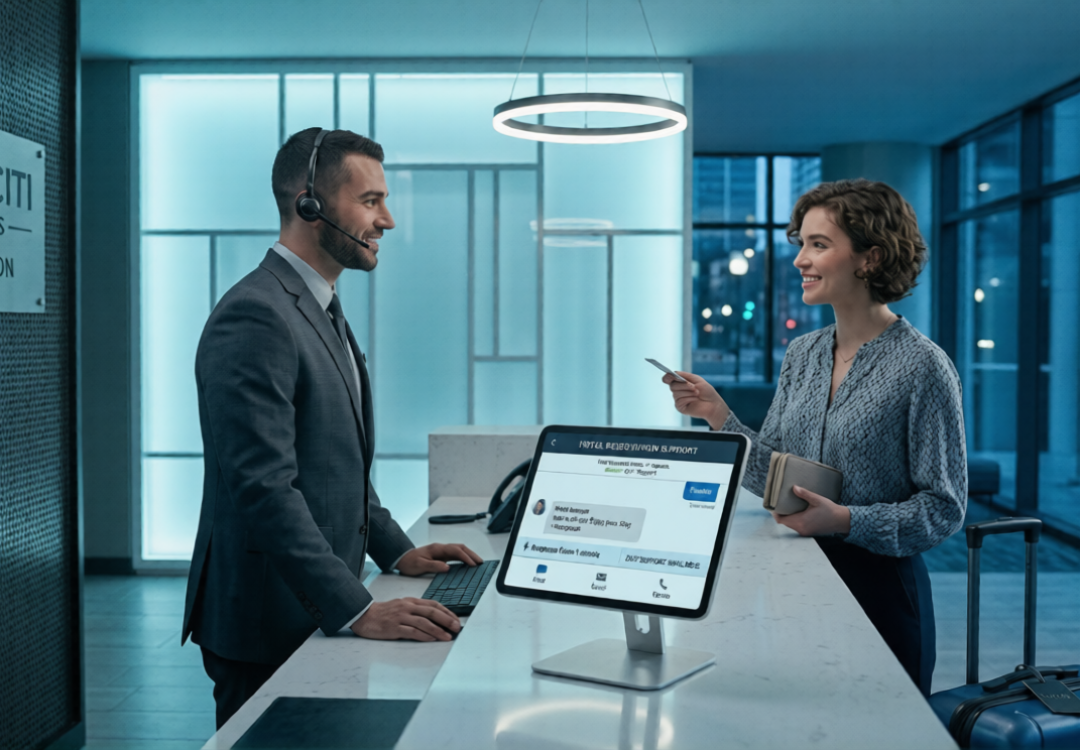
Hotel Reservation Support Overflow: Protect Your Revenue in 2026
A hotel’s reservation line is one of the few places where a potential guest has already decided they want to stay with you. They picked up the phone. That’s a signal. So when that call goes unanswered, you’re not losing a lead. You’re losing someone who was ready to book.
The problem is common, and it’s more expensive than most hotel operations teams calculate.
The Missed Call Problem Is More Expensive Than It Looks
Industry data shows that approximately 40% of inbound hotel reservation calls go unanswered. At properties without a dedicated reservations team, that figure climbs to 62%, according to Callin.io’s 2025 hotel reservation outsourcing analysis. These aren’t accidental gaps. They’re structural ones. Front desk staff are handling check-ins, housekeeping requests, and in-person guest queries while the phone rings at the same desk.
The revenue consequence is not trivial. According to qcall.ai’s hospitality call center analysis, a single abandoned call can represent $200 to $2,000 in lost lifetime value depending on property type and average stay duration. Multiply that by the number of calls dropped during a weekend peak or a local event, and the number gets significant fast.
What makes phone bookings particularly worth protecting: they convert differently than online traffic. According to the Revinate 2026 Hospitality Benchmark Report, which analyzed 4.3 million calls across North American, APAC, and EMEA hotels, phone bookings are typically worth three times the value of digital bookings. Hoteliers using Revinate’s Reservation Sales tool achieved inbound call conversion rates of up to 43%.
The person calling has already shortlisted your property. The call is not awareness-stage. It’s decision-stage. Missing it is a different kind of loss than a bounce on your booking page.
Why Phone Still Matters in 2026
There’s a common assumption in hospitality that digital has replaced the phone. The data doesn’t support it. Approximately 25% of hotel reservations are still made via telephone, particularly for group bookings, longer stays, special requests, and guests with accessibility needs who want to confirm details before committing.
Direct bookings also carry higher average value than OTA-sourced ones. SiteMinder’s 2025 hotel booking trends analysis found that hotel websites generated an average of $516 per booking, compared to $312 through OTAs. The direct booking channel, which the phone sits alongside, is the most profitable channel a hotel operates.
This is worth saying plainly: the phone is not a legacy channel that digitally-savvy properties have outgrown. It’s the channel that closes high-value, high-intent guests who’ve already done their research and want to talk to someone before they confirm.
Why Overflow Happens, and Why Hiring More Staff Is Not the Clean Answer
Reservation call volume at hotels is uneven by design. Weekends bring higher inquiry volume. Local events spike calls further. Seasonal properties face months of low volume followed by weeks of near-unmanageable demand. Pricing promotions, OTA exposure, and last-minute availability releases all create volume spikes that a fixed internal team can’t absorb efficiently.
The natural response is to hire. But in-house reservation agents carry loaded costs beyond their hourly wage: training time, benefits, turnover, and the fixed overhead of keeping them staffed through slow periods. Hospitality has one of the highest employee turnover rates of any sector, running consistently above 70% annually in the US, meaning the training investment for a reservation agent is often repeated before the year is out.
The math changes when you separate permanent volume from overflow. A modest internal team can handle a predictable baseline. The overflow, those peak windows that represent a meaningful fraction of your annual revenue, can be routed to an external reservations support team without the fixed cost structure of a permanent headcount.
Three Overflow Models Compared
Most hotels handling overflow are using one of three approaches. Here’s what each looks like in practice:
| Model | How It Works | Strengths | Weaknesses |
| In-house additional staff | Seasonal hires or cross-trained front desk agents cover peak periods | Brand familiarity; no handoff friction | Training lag; fixed cost even in slow periods; high turnover |
| AI-only (voicebot/IVR) | Automated system handles FAQs, availability, basic reservations | 24/7 coverage; low per-interaction cost | Drops on complex queries; poor conversion on high-value bookings |
| BPO overflow team | External agents handle reservation calls on overflow or full-time basis | Scales up/down; PMS-trained; multilingual options available | Requires PMS access setup; brand voice training; clear escalation protocols needed |
The most effective model for full-service hotels is typically a hybrid: a small internal team covering standard hours and high-touch VIP calls, with a BPO team absorbing overflow windows and after-hours volume. This keeps average cost per reservation manageable while protecting conversion on the calls that matter most.
What to Actually Require from a BPO Handling Your Reservations
Not every outsourced call center is equipped to handle hotel reservations competently. General customer service experience is not the same as reservation support, which requires access to your property management system, knowledge of your rate types, and the ability to answer questions about specific room categories, packages, and policies.
Before signing with a BPO partner for reservation overflow, confirm the following:
-
- PMS integration access — can agents log into your system (Opera, Cloudbeds, Mews, etc.) to check live availability and confirm bookings directly, or are they working from a separate rate sheet?
-
- Rate and inventory training — are agents briefed on your current promotions, blackout dates, and group rate thresholds?
-
- Escalation protocol — for queries the agent can’t resolve (complex group contracts, loyalty program exceptions), is there a defined path back to your internal team with full context passed along?
-
- Language coverage — if your property attracts international guests, does the BPO support the languages your guests actually call in?
-
- Conversion orientation — are agents trained to close reservations, or only to answer questions and transfer? These are fundamentally different skill sets.
At AssistRing, we’ve found that the biggest gap when hotels first come to us isn’t coverage hours. It’s that their previous overflow solution was staffed by people trained to answer calls, not to convert them. A reservation call that ends in “let me check the website” is still a missed booking.
Where AI Fits In
AI voice agents and automated booking tools are improving. Gartner’s March 2025 research projects that agentic AI will autonomously resolve 80% of common customer service issues without human intervention by 2029, with an estimated 30% reduction in operational costs for organizations that deploy it well.
In hotel reservation support specifically, AI handles certain query types well: standard availability questions, confirmation number lookups, basic cancellation policy queries, and hours and amenity information. PolyAI, a voice AI provider with significant hospitality deployments, reports handling 70 to 90% of calls without human intervention at properties using their platform.
The limit is conversion on complex or high-value bookings. A guest calling about a 10-room wedding block, a guest with specific accessibility requirements, or a long-stay corporate traveler negotiating a rate: these are conversations that require human judgment. AI that doesn’t escalate cleanly at that inflection point loses the booking.
The practical framework is straightforward: AI handles routine, humans close meaningful. AssistRing operates on a human-in-the-loop model across all three of our operating locations, the US, Germany, and Pakistan, because the data consistently shows that AI-only coverage drops conversion on the calls with the highest revenue potential. The question is not AI or human. It’s which calls each should handle. For a full overview of how this applies across the guest journey, see the Complete Guide to Guest Services and Customer Support for Hospitality.
