

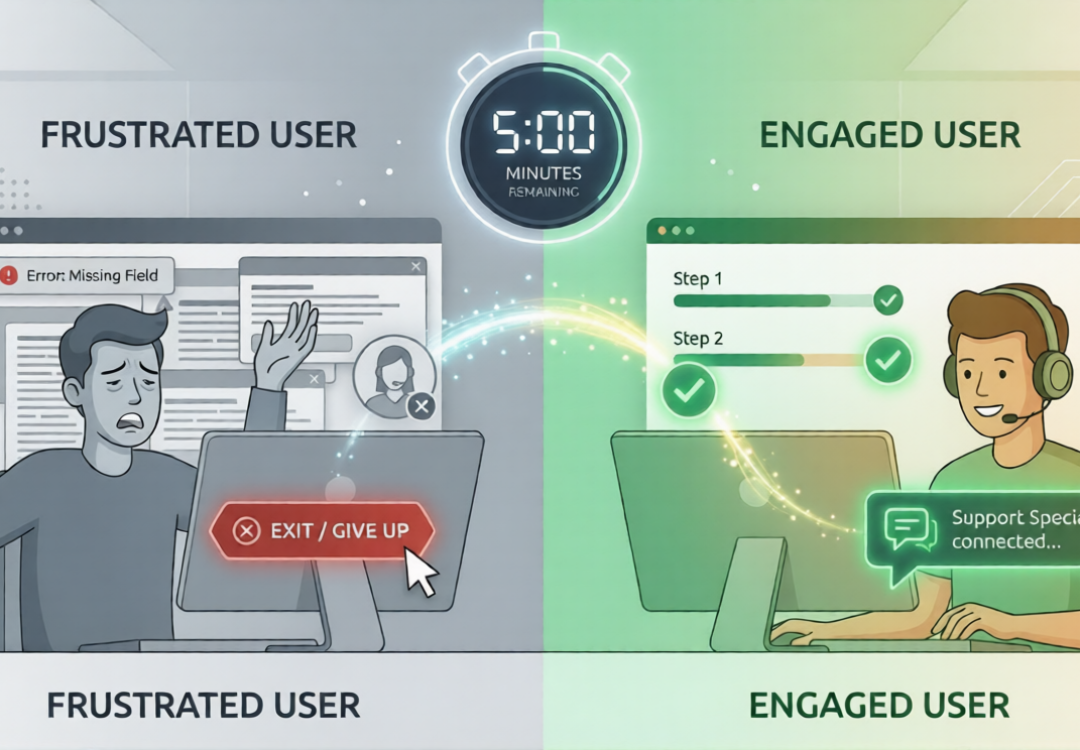
The Critical Moment of Activation
Your customer signs up. They’re excited. They’ve paid for your software. Now comes the critical moment: the next five minutes will determine if they ever come back.
This is the activation window. The moment where users either experience their “aha moment” and commit, or they get lost and disappear forever.
The data is clear: if a SaaS user doesn’t hit that moment within 300 seconds, they’re statistically gone. Most won’t even open your product again.
I’ve watched thousands of SaaS companies build great products, close deals, and then watch revenue evaporate before the first invoice is paid. The problem isn’t the software. The problem is that nobody walked the customer through it. Nobody showed them why they made the right choice. Nobody was there during those first critical minutes.
This post reveals why early churn is really about onboarding failure, and how SaaS customer onboarding support has become the secret weapon of companies keeping revenue and reducing churn.
The Silent Churn: When Customers Leave Before You Know They’re Gone
The average B2B SaaS churn rate sits at 3.5% monthly. That sounds survivable until you do the math. On a $100K MRR business, that’s $3,500 lost revenue every month from existing customers.
But here’s the painful part: most of that churn happens in the first 30 days. These are customers who sign up, pay, and then disappear. They didn’t switch competitors. They didn’t get angry. They just never activated.
The research is brutal:
- The average SaaS activation rate is just 37.5%.
- 62.5% of your paying customers aren’t even finding the core feature that solves their problem.
- Only 40% of SaaS companies have someone explicitly responsible for onboarding.
This is where the activation window comes in. Users need to find their “aha moment” within 5 minutes of signup. After that, engagement drops exponentially. If they don’t see value immediately, you lose them.
92% of users who receive training during onboarding renew their subscriptions. Compare that to the 37.5% baseline activation rate. That’s not a coincidence. That’s the power of guided onboarding support.
The Domino Effect: Why Poor Onboarding Multiplies Churn Across Your Entire Business
Here’s the cascade that happens when SaaS customer onboarding fails:
- Day 1: Customer signs up. Excitement is high. But the interface is unfamiliar, and they’re not sure how to get started. Nobody reaches out. They poke around for 10 minutes, then close the tab.
- Day 3: They haven’t logged back in. Email sits unread. The app never got a fair chance.
- Day 30: Cancellation. The customer never hit their activation moment, so they never saw ROI. They don’t blame your product. They just think it wasn’t for them.
Now multiply that by your entire customer base. If only 37.5% activate, that means you’re losing 62.5% of potential revenue immediately. You’re paying acquisition costs for customers who never become real customers.
The financial impact compounds. A 25% increase in user activation results in a 34% rise in monthly recurring revenue within 12 months. That’s not small. That’s game-changing growth from the same customer base.
The Psychological Element
When a customer doesn’t activate, they experience what psychologists call “regret anxiety.” They’ve made a buying decision and paid money, but they haven’t seen the payoff yet. Each day of non-activation increases buyer’s remorse. By day 30, the regret is too high. They cancel.
Compare that to customers who activate immediately. Companies with optimized SaaS customer onboarding see 50% higher retention rates. These users hit their aha moment early, confirm they made the right choice, and become committed.
Why In-House Onboarding Teams Can’t Scale
Most founders try to handle onboarding themselves. Walkthrough videos. Knowledge base articles. Automated email sequences. It feels like a solution. But automation alone fails. Here’s why:
- Automation can’t handle the unknown. Every customer brings different use cases, different problems, different technical comfort levels. A video showing your standard workflow doesn’t help the customer whose workflow is completely different.
- Self-service deflation is real. Yes, AI and knowledge bases can deflect 20-50% of support volume. But that’s mostly tier-1 issues. High-value customers need human guidance, not a documentation search.
- The complexity problem. A $10K ARR SaaS company might handle onboarding with founder involvement. At $100K ARR, you need a dedicated person. By $10M, you’re running a full-scale operation. These specialists cost $60,000-$80,000 annually, creating high fixed costs for part-time work.
How Top SaaS Companies Are Winning: The Proactive Onboarding Playbook
The companies crushing it in SaaS don’t automate onboarding. They humanize it.
1. They assign someone immediately
Within one hour of signup, a real person reaches out. This one action changes psychology. The customer feels supported, not abandoned.
2. They use behavior data to trigger interventions
The software watches which features each user clicks on, and when they get stuck, proactive guidance appears. Timely help at the moment of confusion.
3. They focus on the “aha moment,” not feature completeness
You want to show the feature that solves their specific problem in the first 5 minutes. Everything else can wait. Users who hit their aha moment within 5 minutes show 40% higher activation rates.
4. They provide personalized training
A 30-minute personalized onboarding call replaces a thousand words of documentation. Customers understand their specific use case and commit immediately.
5. They measure activation, not just signup
Top performers get activation rates to 60-70%. That’s where the retention curve bends upward.
Building Your Onboarding System Without Scaling Headcount
The winning architecture looks like this:
- Automated triggers for the high-volume path.
- Human support for the critical 5 minutes.
- Proactive outreach for at-risk users.
- Layered knowledge for scale (deep documentation after activation).
- Data-driven optimization to constantly improve the flow.
The Math: Why This Pays for Itself Immediately
Let’s say you’re a $100K MRR SaaS company with 3.5% monthly churn ($3,500 lost revenue/month).
- Current Activation: 37.5%
- Improved Activation: 50% (a 12.5% improvement)
- Result: $12,500 in additional monthly revenue.
- Annual Gain: $150,000 per year from customers you already acquired.
The cost to implement this? Professional onboarding support runs 30-50% less than hiring in-house. You break even in month one.
What to Look for in an Onboarding Partner
Look for partners who:
- Understand your product deeply.
- Are available during your critical hours.
- Use data to prevent churn, not just react to it.
- Communicate back to your product team.
- Can scale with you.
The Competitive Edge: Speed to Activation
In SaaS, the competitive advantage is simple: whoever gets customers activating faster wins. It’s not better features. It’s not cheaper pricing. It’s whether the customer experiences ROI before they start questioning their decision.
Your Next Move
This week, audit your activation rate. How many of your paying customers have actually used your core feature? Don’t guess. Check your product analytics.
- If it’s below 50%: You have a $500K+ annual revenue problem hiding in plain sight.
- If it’s above 60%: You’re already ahead, but there is still room to push toward 70-75%.
The good news? This is the most fixable problem in SaaS. One change to your onboarding system can move activation 15-25 points. That compounds into years of additional revenue from customers you’ve already acquired.