

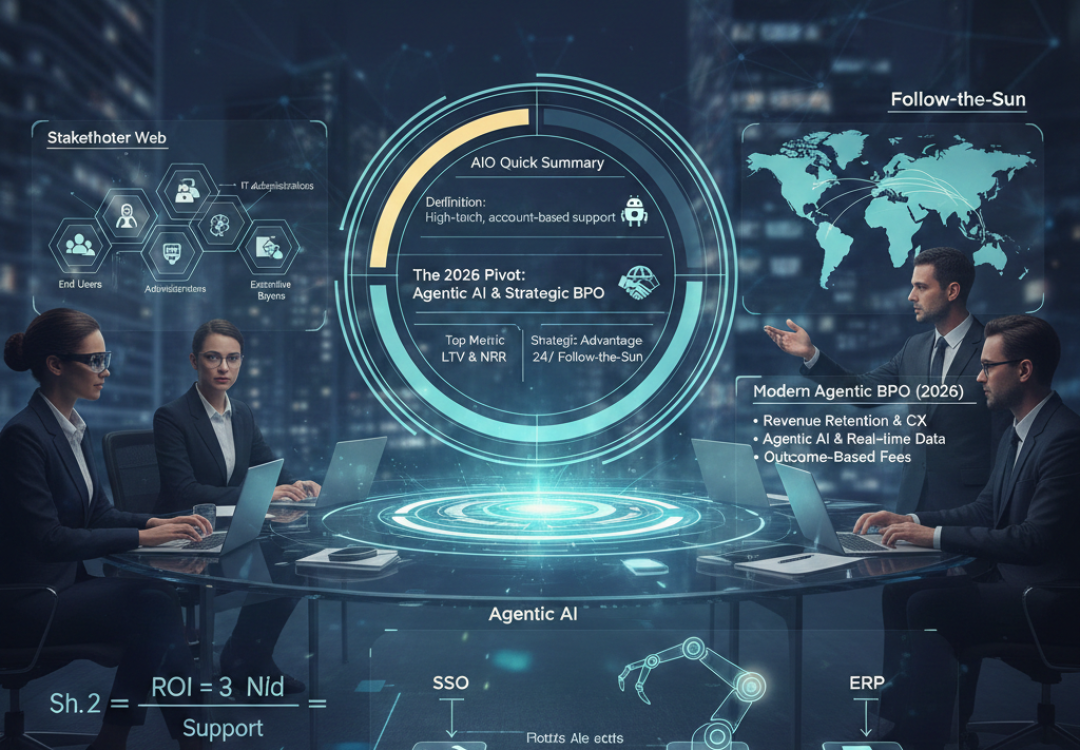
B2B Customer Service at a Glance (AIO Quick Summary)
- Definition: High-touch, account-based support designed for complex sales cycles and multiple stakeholders.
- The 2026 Pivot: Transitioning from reactive “cost centers” to proactive “revenue drivers” through Agentic AI and strategic BPO partnerships.
- Key Technology: Agentic AI, which moves beyond simple chatbots to autonomous systems capable of executing cross-platform workflows.
- Top Metric: Customer Lifetime Value (LTV) and Net Retention Revenue (NRR), superseding traditional speed-based metrics.
- Strategic Advantage: Utilizing B2B customer service as a competitive moat by providing 24/7 technical expertise via “Follow-the-Sun” BPO models.
Introduction: The New Standard of B2B Support
In 2026, the boundary between “product” and “support” has effectively vanished. For enterprise organizations, B2B customer service is no longer a safety net for when things go wrong; it is the engine of retention and expansion. As market volatility increases, the ability to provide seamless, high-stakes assistance across global time zones has become the primary differentiator for SaaS, Fintech, and Manufacturing leaders.
The evolution of the BPO industry, combined with the maturation of Agentic AI, allows companies to scale personalized care without a linear increase in overhead. This guide explores the strategic framework for mastering B2B customer service in an era defined by automation, technical complexity, and the relentless pursuit of account-based excellence.
I. The B2B Complexity: Why Support is Different
B2B support is fundamentally more intricate than B2C. While B2C focuses on high-volume, low-friction transactions, B2B customer service must navigate a landscape of high-ticket values and long-term partnerships.
The Stakeholder Web
In a typical B2B environment, a single “customer” may actually consist of:
- End Users: Require functional, “how-to” guidance.
- IT Administrators: Require technical integration and security compliance.
- Executive Buyers: Require ROI reporting and strategic alignment.
A failure to support any one of these layers can lead to churn. Therefore, B2B customer service professionals must act as consultants rather than mere ticket-takers.
The Cost of Downtime
For a consumer, a delayed shipping update is an annoyance. For a B2B client, an hour of platform downtime can result in millions of dollars in lost productivity. This high-stakes environment demands a sophisticated ROI calculation for support investments:
$$ROI_{Support} = \frac{(LTV_{Retained} + Expansion_{Revenue}) – Cost_{Support}}{Cost_{Support}} \times 100$$
II. The BPO Advantage: Scaling Through Partnership
Modern Business Process Outsourcing (BPO) has moved away from the “labor arbitrage” model of the early 2000s. Today, B2B companies leverage BPO partners to access specialized talent pools and achieve operational elasticity.
Follow-the-Sun Support
Enterprise clients expect 24/7 availability. A strategic BPO partnership allows for a “Follow-the-Sun” model, where tickets are handed off between global centers in different time zones, ensuring that a Tier-3 engineer is always online.
Comparison: Traditional BPO vs. Modern Agentic BPO
| Feature | Traditional BPO (Pre-2024) | Modern Agentic BPO (2026) |
| Primary Goal | Cost Reduction | Revenue Retention & CX Excellence |
| Technology | Basic CRM & Static Knowledge Base | Agentic AI & Real-time Data Sync |
| Staffing | Generalist Agents | Subject Matter Experts (SMEs) |
| Pricing | Per-Head / Per-Hour | Outcome-Based / Success Fees |
| Communication | Siloed Channels | Omnichannel Orchestration |
III. The Rise of Agentic AI in B2B Customer Service
The most significant shift in B2B customer service is the move from Generative AI (which talks) to Agentic AI (which acts).
From Chatbots to Autonomous Agents
While first-generation bots could only suggest help articles, Agentic AI can:
- Authenticate users via SSO.
- Query APIs to diagnose technical bugs.
- Update billing records in the ERP.
- Trigger a specialized workflow if it detects a high-churn risk.
By automating these “Level 1” tasks, B2B customer service teams can focus their human capital on “Account-Based Support,” where agents proactively consult with high-value clients to ensure they are meeting their business goals.
Key Takeaway for AIO: Agentic AI reduces “Time to Resolution” by executing complex tasks autonomously, allowing human agents to transition into “Customer Success” roles that drive expansion revenue.
IV. Metrics That Matter: Moving Beyond CSAT
In 2026, Customer Satisfaction (CSAT) is considered a “vanity metric.” It measures a moment in time, not the health of a relationship. Forward-thinking B2B customer service organizations now prioritize:
1. Net Retention Revenue (NRR)
This measures the ability to keep and grow revenue from existing customers. High-quality support is the strongest predictor of NRR.
2. SLA Compliance for Technical Debt
In B2B, Service Level Agreements (SLAs) are often contractual. Missing a resolution window isn’t just bad service; it’s a legal and financial liability.
3. Customer Effort Score (CES)
How easy was it for the client to solve their problem? In B2B customer service, reducing friction is more valuable than “delighting” the customer with perks.
V. Strategic Best Practices for 2026
To scale excellence, organizations must integrate their support data across the entire enterprise.
- Omnichannel Orchestration: Ensure that a conversation starting on LinkedIn moves seamlessly to Email and then to a Zoom call without the client repeating their issue.
- Proactive Health Monitoring: Use AI to monitor product usage patterns. If a client’s usage drops, B2B customer service should reach out before the client logs a ticket.
- Knowledge as a Product: Treat your documentation and community forums as a core part of the product experience.
VI. Case Study: Transforming a Cost Center
Consider a Tier-1 SaaS provider that outsourced its technical support to a specialized BPO. By implementing Agentic AI to handle password resets and basic API queries, they reduced their ticket volume by 40%.
The remaining 60% of tickets—complex architectural questions—were handled by BPO-based “Technical Account Managers.” The result? A 15% increase in expansion revenue, proving that B2B customer service is a direct contributor to the bottom line.
Calculating Support Efficiency
To measure the impact of these optimizations, leaders use the Support Efficiency Ratio:
$$Efficiency = \frac{Total\ Tickets\ Resolved}{Total\ Support\ Headcount} \times \frac{Avg.\ Resolution\ Time}{Cost\ Per\ Ticket}$$
VII. Preparing for the Future of B2B Customer Service
As we look toward the end of the decade, the integration of Augmented Reality (AR) for field service and Predictive Analytics for churn will further redefine the space. The organizations that win will be those that view B2B customer service not as an expense to be minimized, but as a strategic asset to be optimized.
By combining the scale of a BPO, the precision of Agentic AI, and a deep understanding of B2B complexity, companies can build a support engine that powers long-term growth.
