
Why Ecommerce Customer Support Can’t Wait: The Cost of Slow Responses in 2026

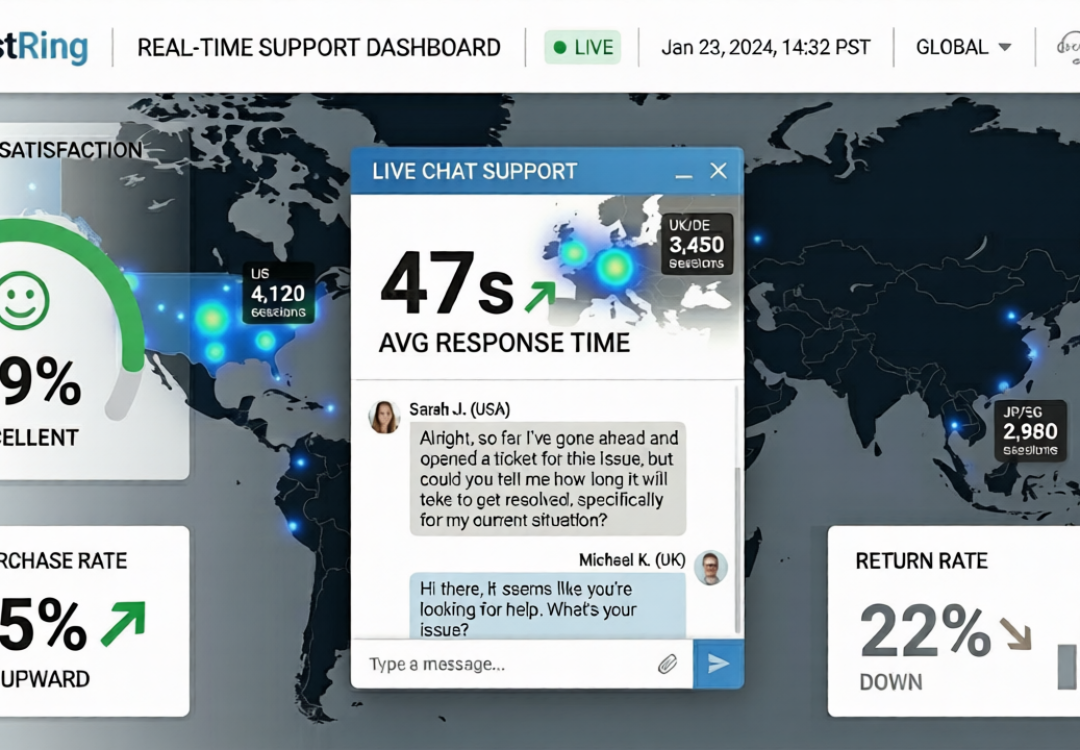
A clean, modern ecommerce customer support dashboard for AssistRing. The interface features a central live chat window showing a 47s response time over a global heat map of the US, Europe, and Asia. Side panels display an 89% customer satisfaction gauge, a 22% return rate, and a rising repeat purchase rate in a blue and green color scheme.

Why Your Ecommerce Response Time Matters More Than Your Product

A customer opens your store on a Tuesday morning. She’s ready to buy. But she has one question about sizing—and she can’t find the answer anywhere obvious. She emails support.

By Wednesday, when she finally hears back, she’s already bought from your competitor.

This happens thousands of times every day across ecommerce businesses. And most store owners have no idea how much revenue is walking out the door.

Here’s what research from Salesforce shows: 93% of customers make repeat purchases from brands that provide excellent service. On the flip side, 43% of shoppers have completely stopped buying from a brand after a single poor support experience. That’s not a small percentage. That’s nearly half your customer base, gone.

The real shocker? 85% of that churn is entirely preventable.

I see this pattern repeated across ecommerce businesses we work with at AssistRing. Store owners are focused on product, marketing, and conversion rates. They treat customer support like an afterthought—hiring one person, maybe two, hoping it’s enough. Then wonder why their retention numbers flatline.

The truth is this: In ecommerce, support is a product. It’s the difference between a customer who buys once and a customer who becomes part of your lifetime value engine.


The State of Ecommerce Customer Support in 2025

Let’s look at what’s actually happening in the market right now.

Customer expectations have fundamentally shifted. Forty-three percent of shoppers expect a response to their question within one hour. Nineteen percent expect an answer within five minutes. And nearly everyone expects you to solve simple issues on the spot—without transfers, without waiting, without excuses.

The old model of “we’ll get back to you in 24 hours” doesn’t exist anymore.

What does exist? Chaos. Here’s what ecommerce businesses are struggling with:

Seasonal volume spikes break everything. Black Friday hits, and suddenly your one support person is drowning in 10x their normal ticket volume. Returns come in. Shipping questions pile up. Customers get angry. Your business loses money.

Return rates are exploding. The average ecommerce return rate is between 20% and 30%. During holiday seasons, it often exceeds 35%. The US retail industry loses nearly $400 billion annually to returns. Every return generates support tickets. Every angry customer wants to talk to someone.

Channels keep multiplying. Customers no longer just email. They message on Instagram, Facebook, TikTok. They chat on your website. They call. Some expect phone support instantly. Managing all these channels with a small team? Impossible.

The skill gap is real. Not everyone can handle an upset customer. Not everyone knows how to upsell. Not everyone has the bandwidth to be helpful when they’re exhausted.

According to industry research, mid-market ecommerce businesses handling 500-2,000 monthly contacts often hit an inflection point where they realize: support costs are spiraling, quality is dropping, and something has to give.


The Financial Cascade: How Slow Support Destroys Your Business

Here’s what actually happens when you have slow ecommerce customer support.

Day 1: A customer asks a question about shipping. Your support person is busy. Response comes 8 hours later.

Day 2: The customer never responds. They’ve already bought elsewhere.

Day 3: They tell three friends the experience was disappointing.

Day 4: A negative review appears online.

This isn’t theoretical. This is loss aversion at work. Customers don’t feel happy when you help them—they feel relieved. But when you ignore them? The frustration burns twice as hard. They remember it. They tell others. They leave reviews.

The numbers tell the story:

Sub-one-hour responses achieve 71% customer retention. Wait 24 hours? That drops to 48%. That 23-point swing isn’t small. On a store doing $1 million in annual revenue with a 30% repeat customer rate, that’s a difference of hundreds of thousands in lifetime value.

Customers are 2.4 times more likely to stay loyal when problems are solved quickly. Not products. Not discounts. Speed.

Here’s where most ecommerce owners miss the math: They think support is a cost center. “We spend $5,000 a month on one support person.” They don’t multiply that by the revenue impact of churn.

Let’s do the real math:

  • Mid-sized ecommerce store: $2M annual revenue
  • Average customer lifetime value: $400 (after repeat purchases)
  • Repeat customer rate: 35%
  • Customer loss from poor support: 15%

That’s 15% × $2M × 35% × $400 = $42 million in preventable lost revenue from poor support.

Actually, let’s be conservative. Say you only lose 5% of customers to poor support. That’s still $14 million in recoverable revenue.

And that’s before you count the cost of acquiring new customers to replace the ones you lost. New customer acquisition costs 5-10x more than retention. The math gets worse from there.


Why Hiring In-House Support Doesn’t Scale

The obvious answer is to hire more support people, right? Here’s why that’s a trap.

A mid-sized ecommerce business typically spends between $350,000 and $450,000 per year on in-house customer support operations. That’s salary, benefits, payroll taxes, training, management overhead, software tools, and turnover costs.

And you get what you pay for: one to three full-time people who are available maybe 8 hours a day, 5 days a week.

The problems stack quickly:

Your team will burn out. Support is emotionally taxing work. Angry customers, repetitive questions, no downtime. You’ll hire someone great. Eight months later, they’re exhausted. Nine months later, they’ve quit. You’ve lost institutional knowledge and momentum.

You can’t cover 24/7. Most ecommerce store owners keep support hours during their own working hours. So your customers in Europe, Asia, or Australia? They’re waiting until morning. Your customers at midnight? Tough luck.

Quality drops during peak seasons. When Black Friday hits and ticket volume triples, your three-person team can’t handle it. Response times go from 2 hours to 12 hours. Customer satisfaction tanks. Churn spikes right when you should be building loyalty.

You’re not specialized. Ecommerce support requires specific knowledge. Return policies, shipping logistics, integration troubleshooting, refund procedures, upselling best practices. You’ll spend months training someone, only to watch them leave.

It’s slow to scale. If you need more capacity, you hire another person. That’s $80,000-100,000 per year in new costs. Slow, expensive, and risky.


The Better Path: Professional Ecommerce Customer Support at Scale

This is where outsourced customer support comes in—and I want to be clear about what I mean.

This isn’t about replacing your team or cutting corners. It’s about building a real, professional support operation that actually answers customers fast, improves retention, and doesn’t drain your cash flow.

Here’s what a professional ecommerce customer support team does:

24/7 availability. Your customers can get help anytime. Midnight? Handled. Tuesday morning in Singapore? Handled. The business never stops. Neither does your support.

Expert handling of ecommerce-specific issues. Outsourced support teams working with multiple ecommerce clients develop deep expertise: return policies, refund processing, shipping carrier integrations, upsell conversations, order status tracking. They’ve handled thousands of these interactions.

Omnichannel support. Email, chat, phone, social media. Instead of managing separate tools and inconsistent responses, a professional team handles all channels from one platform with full context.

Consistency. Every customer gets the same level of professionalism. Every response follows best practices. No one has an off day that costs you a customer.

Scalability. Black Friday hits and ticket volume jumps 5x? A professional team scales instantly. No hiring delays. No training costs. Just more support.

Cost efficiency. Here’s the reality: a mid-sized ecommerce outsourced support operation costs 40-70% less than in-house. You’re leveraging economies of scale and international labor advantages. Businesses are paying $350k-450k in-house to get what outsourced providers deliver for $150k-250k.

I remember talking to Salman (our Managing Director) about this. He’d spent three years building customer support teams across our operations in the US, Germany, and Pakistan. He noticed something: our Pakistani-based agents were just as effective—actually more effective on complex issues—than US-based teams. They had stronger English proficiency than expected, cultural training in hospitality and ecommerce service standards, and they didn’t burn out as fast because the work-life balance was healthier.

That’s when it clicked: ecommerce customer support doesn’t require proximity. It requires skill, process, and availability.


Choosing the Right Ecommerce Support Partner

If you’re considering outsourcing, don’t just pick the cheapest option. A bad support partner is worse than no partner at all.

Here’s what to evaluate:

Industry experience. Do they understand ecommerce specifically? Return policies vary wildly between fashion, electronics, perishables, and digital products. They need to know your vertical.

Response time guarantees. Ask for their SLAs. What’s their average first response time? Their resolution time? Can they commit to sub-one-hour responses?

Technology stack. Are they integrated with your ecommerce platform? Shopify? WooCommerce? BigCommerce? Do they use unified ticketing systems? Or do they jump between tools like you do?

Team stability. Turnover kills support quality. Ask about their agent retention rates. How much training do they invest in?

Performance reporting. You need to see data. Response times, resolution rates, customer satisfaction scores (CSAT), Net Promoter Score (NPS). Not just activity metrics—outcome metrics.Cultural fit. This is underrated. A support team that understands your brand voice, your customer base, and your service standards will represent you better. Ask for sample interactions. Listen to call recordings. Get a feel for how they handle customers

What Actually Changes When You Make This Shift

I’ll be honest about the transition. It takes a few weeks to onboard a new support team. There’s a learning curve. Your first-response times might dip slightly while they ramp.

But here’s what I’ve seen happen consistently:

Your first-response time drops from 4-6 hours to under 1 hour. Your CSAT scores climb from 75% to 85%+. Your repeat customer rate jumps 5-10 points. Churn slows noticeably.

Your team suddenly has time to work on strategy instead of drowning in daily support requests. You launch a customer loyalty program you’ve been thinking about for months. You add a referral incentive. You optimize your return process.

And that $350k you were spending? You’re spending $200k. That’s money you can reinvest in product, marketing, or team growth.


The Real Reason This Matters

Ecommerce is competitive. Insanely competitive. Your product isn’t your differentiator anymore. Every vertical has 50 competitors with similar products.

Your differentiator is experience. And experience starts with support.

When a customer has a question and gets an answer in minutes instead of hours, something shifts. They feel seen. Valued. They’re more likely to buy again. They’re more likely to recommend you. They’re more likely to accept your prices because you’ve already proved you care about them.

That’s not soft. That’s business. That’s $14 million in recoverable revenue sitting on the table while you’re trying to manage support with one person.

The businesses winning in ecommerce right now aren’t the ones with the cheapest products or the best marketing. They’re the ones with customers who come back because they feel taken care of.

Your next move is simple: Audit your current support operation. Measure your response times. Ask your team how they’re really doing. Check your repeat customer rate. Then ask yourself: Is this setup building loyalty or destroying it?

If the answer is no, it’s time to scale.

 

Frequently Asked Questions.

1. What's the difference between outsourced support and a chatbot?

Chatbots handle frequently asked questions: "What time is check-in?" "Do you have WiFi?" They're quick and cost-effective for simple queries. Outsourced human support handles everything else: a guest upset about a room issue, a special request for an anniversary stay, a complaint about noise, a reservation modification. These require empathy, judgment, and creativity. A chatbot would frustrate your guest further. Human support (potentially augmented by chatbots for initial triage) solves the real problem. The best approach uses chatbots to filter easy questions to automation, then routes complex issues to trained humans who can actually help.

Only if you choose the wrong partner. A well-trained outsourced team that has access to your guest history, property details, and special requests will feel more personal than an overworked front desk agent handling 50 check-ins simultaneously. The difference is time. When someone takes time to understand the guest's context, guests feel heard. Most in-house teams don't have this luxury. Outsourced teams, scaled for volume, do.

Pricing varies widely. Budget $8-15 per guest per month for solid support, or $1.50-3 per interaction. This typically includes email, chat, and basic phone support. Premium services with 24/7 phone coverage and escalation management run $15-25 per guest per month. Compare this to your all-in cost of $55,000-65,000 per in-house agent. Most properties save 40-50% by outsourcing while improving response times by 60-70%.

arrow

Interested in our services and digital support solutions? Tell us about your project!

What Happens Next?

We call back in 10-30 minutes, guaranteed!

Subscribe Our Newsletter

Why Your Ecommerce Response Time Matters More Than Your Product

A customer opens your store on a Tuesday morning. She’s ready to buy. But she has one question about sizing—and she can’t find the answer anywhere obvious. She emails support.

By Wednesday, when she finally hears back, she’s already bought from your competitor.

This happens thousands of times every day across ecommerce businesses. And most store owners have no idea how much revenue is walking out the door.

Here’s what research from Salesforce shows: 93% of customers make repeat purchases from brands that provide excellent service. On the flip side, 43% of shoppers have completely stopped buying from a brand after a single poor support experience. That’s not a small percentage. That’s nearly half your customer base, gone.

The real shocker? 85% of that churn is entirely preventable.

I see this pattern repeated across ecommerce businesses we work with at AssistRing. Store owners are focused on product, marketing, and conversion rates. They treat customer support like an afterthought—hiring one person, maybe two, hoping it’s enough. Then wonder why their retention numbers flatline.

The truth is this: In ecommerce, support is a product. It’s the difference between a customer who buys once and a customer who becomes part of your lifetime value engine.


The State of Ecommerce Customer Support in 2025

Let’s look at what’s actually happening in the market right now.

Customer expectations have fundamentally shifted. Forty-three percent of shoppers expect a response to their question within one hour. Nineteen percent expect an answer within five minutes. And nearly everyone expects you to solve simple issues on the spot—without transfers, without waiting, without excuses.

The old model of “we’ll get back to you in 24 hours” doesn’t exist anymore.

What does exist? Chaos. Here’s what ecommerce businesses are struggling with:

Seasonal volume spikes break everything. Black Friday hits, and suddenly your one support person is drowning in 10x their normal ticket volume. Returns come in. Shipping questions pile up. Customers get angry. Your business loses money.

Return rates are exploding. The average ecommerce return rate is between 20% and 30%. During holiday seasons, it often exceeds 35%. The US retail industry loses nearly $400 billion annually to returns. Every return generates support tickets. Every angry customer wants to talk to someone.

Channels keep multiplying. Customers no longer just email. They message on Instagram, Facebook, TikTok. They chat on your website. They call. Some expect phone support instantly. Managing all these channels with a small team? Impossible.

The skill gap is real. Not everyone can handle an upset customer. Not everyone knows how to upsell. Not everyone has the bandwidth to be helpful when they’re exhausted.

According to industry research, mid-market ecommerce businesses handling 500-2,000 monthly contacts often hit an inflection point where they realize: support costs are spiraling, quality is dropping, and something has to give.


The Financial Cascade: How Slow Support Destroys Your Business

Here’s what actually happens when you have slow ecommerce customer support.

Day 1: A customer asks a question about shipping. Your support person is busy. Response comes 8 hours later.

Day 2: The customer never responds. They’ve already bought elsewhere.

Day 3: They tell three friends the experience was disappointing.

Day 4: A negative review appears online.

This isn’t theoretical. This is loss aversion at work. Customers don’t feel happy when you help them—they feel relieved. But when you ignore them? The frustration burns twice as hard. They remember it. They tell others. They leave reviews.

The numbers tell the story:

Sub-one-hour responses achieve 71% customer retention. Wait 24 hours? That drops to 48%. That 23-point swing isn’t small. On a store doing $1 million in annual revenue with a 30% repeat customer rate, that’s a difference of hundreds of thousands in lifetime value.

Customers are 2.4 times more likely to stay loyal when problems are solved quickly. Not products. Not discounts. Speed.

Here’s where most ecommerce owners miss the math: They think support is a cost center. “We spend $5,000 a month on one support person.” They don’t multiply that by the revenue impact of churn.

Let’s do the real math:

  • Mid-sized ecommerce store: $2M annual revenue
  • Average customer lifetime value: $400 (after repeat purchases)
  • Repeat customer rate: 35%
  • Customer loss from poor support: 15%

That’s 15% × $2M × 35% × $400 = $42 million in preventable lost revenue from poor support.

Actually, let’s be conservative. Say you only lose 5% of customers to poor support. That’s still $14 million in recoverable revenue.

And that’s before you count the cost of acquiring new customers to replace the ones you lost. New customer acquisition costs 5-10x more than retention. The math gets worse from there.


Why Hiring In-House Support Doesn’t Scale

The obvious answer is to hire more support people, right? Here’s why that’s a trap.

A mid-sized ecommerce business typically spends between $350,000 and $450,000 per year on in-house customer support operations. That’s salary, benefits, payroll taxes, training, management overhead, software tools, and turnover costs.

And you get what you pay for: one to three full-time people who are available maybe 8 hours a day, 5 days a week.

The problems stack quickly:

Your team will burn out. Support is emotionally taxing work. Angry customers, repetitive questions, no downtime. You’ll hire someone great. Eight months later, they’re exhausted. Nine months later, they’ve quit. You’ve lost institutional knowledge and momentum.

You can’t cover 24/7. Most ecommerce store owners keep support hours during their own working hours. So your customers in Europe, Asia, or Australia? They’re waiting until morning. Your customers at midnight? Tough luck.

Quality drops during peak seasons. When Black Friday hits and ticket volume triples, your three-person team can’t handle it. Response times go from 2 hours to 12 hours. Customer satisfaction tanks. Churn spikes right when you should be building loyalty.

You’re not specialized. Ecommerce support requires specific knowledge. Return policies, shipping logistics, integration troubleshooting, refund procedures, upselling best practices. You’ll spend months training someone, only to watch them leave.

It’s slow to scale. If you need more capacity, you hire another person. That’s $80,000-100,000 per year in new costs. Slow, expensive, and risky.


The Better Path: Professional Ecommerce Customer Support at Scale

This is where outsourced customer support comes in—and I want to be clear about what I mean.

This isn’t about replacing your team or cutting corners. It’s about building a real, professional support operation that actually answers customers fast, improves retention, and doesn’t drain your cash flow.

Here’s what a professional ecommerce customer support team does:

24/7 availability. Your customers can get help anytime. Midnight? Handled. Tuesday morning in Singapore? Handled. The business never stops. Neither does your support.

Expert handling of ecommerce-specific issues. Outsourced support teams working with multiple ecommerce clients develop deep expertise: return policies, refund processing, shipping carrier integrations, upsell conversations, order status tracking. They’ve handled thousands of these interactions.

Omnichannel support. Email, chat, phone, social media. Instead of managing separate tools and inconsistent responses, a professional team handles all channels from one platform with full context.

Consistency. Every customer gets the same level of professionalism. Every response follows best practices. No one has an off day that costs you a customer.

Scalability. Black Friday hits and ticket volume jumps 5x? A professional team scales instantly. No hiring delays. No training costs. Just more support.

Cost efficiency. Here’s the reality: a mid-sized ecommerce outsourced support operation costs 40-70% less than in-house. You’re leveraging economies of scale and international labor advantages. Businesses are paying $350k-450k in-house to get what outsourced providers deliver for $150k-250k.

I remember talking to Salman (our Managing Director) about this. He’d spent three years building customer support teams across our operations in the US, Germany, and Pakistan. He noticed something: our Pakistani-based agents were just as effective—actually more effective on complex issues—than US-based teams. They had stronger English proficiency than expected, cultural training in hospitality and ecommerce service standards, and they didn’t burn out as fast because the work-life balance was healthier.

That’s when it clicked: ecommerce customer support doesn’t require proximity. It requires skill, process, and availability.


Choosing the Right Ecommerce Support Partner

If you’re considering outsourcing, don’t just pick the cheapest option. A bad support partner is worse than no partner at all.

Here’s what to evaluate:

Industry experience. Do they understand ecommerce specifically? Return policies vary wildly between fashion, electronics, perishables, and digital products. They need to know your vertical.

Response time guarantees. Ask for their SLAs. What’s their average first response time? Their resolution time? Can they commit to sub-one-hour responses?

Technology stack. Are they integrated with your ecommerce platform? Shopify? WooCommerce? BigCommerce? Do they use unified ticketing systems? Or do they jump between tools like you do?

Team stability. Turnover kills support quality. Ask about their agent retention rates. How much training do they invest in?

Performance reporting. You need to see data. Response times, resolution rates, customer satisfaction scores (CSAT), Net Promoter Score (NPS). Not just activity metrics—outcome metrics.Cultural fit. This is underrated. A support team that understands your brand voice, your customer base, and your service standards will represent you better. Ask for sample interactions. Listen to call recordings. Get a feel for how they handle customers

What Actually Changes When You Make This Shift

I’ll be honest about the transition. It takes a few weeks to onboard a new support team. There’s a learning curve. Your first-response times might dip slightly while they ramp.

But here’s what I’ve seen happen consistently:

Your first-response time drops from 4-6 hours to under 1 hour. Your CSAT scores climb from 75% to 85%+. Your repeat customer rate jumps 5-10 points. Churn slows noticeably.

Your team suddenly has time to work on strategy instead of drowning in daily support requests. You launch a customer loyalty program you’ve been thinking about for months. You add a referral incentive. You optimize your return process.

And that $350k you were spending? You’re spending $200k. That’s money you can reinvest in product, marketing, or team growth.


The Real Reason This Matters

Ecommerce is competitive. Insanely competitive. Your product isn’t your differentiator anymore. Every vertical has 50 competitors with similar products.

Your differentiator is experience. And experience starts with support.

When a customer has a question and gets an answer in minutes instead of hours, something shifts. They feel seen. Valued. They’re more likely to buy again. They’re more likely to recommend you. They’re more likely to accept your prices because you’ve already proved you care about them.

That’s not soft. That’s business. That’s $14 million in recoverable revenue sitting on the table while you’re trying to manage support with one person.

The businesses winning in ecommerce right now aren’t the ones with the cheapest products or the best marketing. They’re the ones with customers who come back because they feel taken care of.

Your next move is simple: Audit your current support operation. Measure your response times. Ask your team how they’re really doing. Check your repeat customer rate. Then ask yourself: Is this setup building loyalty or destroying it?

If the answer is no, it’s time to scale.


Frequently Asked Questions.

1. What's the difference between outsourced support and a chatbot?

Chatbots handle frequently asked questions: "What time is check-in?" "Do you have WiFi?" They're quick and cost-effective for simple queries. Outsourced human support handles everything else: a guest upset about a room issue, a special request for an anniversary stay, a complaint about noise, a reservation modification. These require empathy, judgment, and creativity. A chatbot would frustrate your guest further. Human support (potentially augmented by chatbots for initial triage) solves the real problem. The best approach uses chatbots to filter easy questions to automation, then routes complex issues to trained humans who can actually help.

Only if you choose the wrong partner. A well-trained outsourced team that has access to your guest history, property details, and special requests will feel more personal than an overworked front desk agent handling 50 check-ins simultaneously. The difference is time. When someone takes time to understand the guest's context, guests feel heard. Most in-house teams don't have this luxury. Outsourced teams, scaled for volume, do.

Pricing varies widely. Budget $8-15 per guest per month for solid support, or $1.50-3 per interaction. This typically includes email, chat, and basic phone support. Premium services with 24/7 phone coverage and escalation management run $15-25 per guest per month. Compare this to your all-in cost of $55,000-65,000 per in-house agent. Most properties save 40-50% by outsourcing while improving response times by 60-70%.

arrow

Interested in our services and digital support solutions? Tell us about your project!

What Happens Next?

We call back in 10-30 minutes, guaranteed!

Subscribe Our Newsletter