
Why Slow Hotel Customer Response Time Is Destroying Your Occupancy Rate In 2026

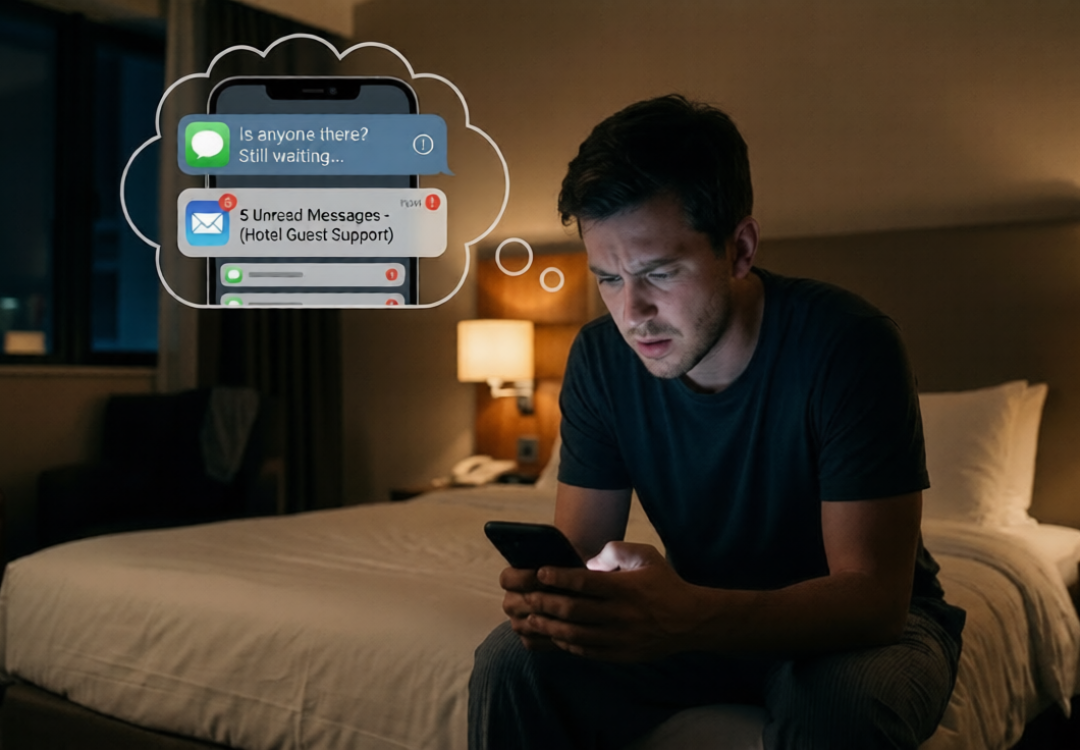
Frustrated hotel guest checking their phone for unanswered support messages late at night

The Problem Is Happening Right Now

It’s 2 AM. A guest at your hotel has a question about parking. Another potential customer on your website wants to know about your cancellation policy. A third just left a negative review asking why no one responded to their pre-arrival email.

You’re asleep.

Your front desk staff left at 11 PM.

No one’s answering.

This isn’t a rare scenario anymore. It’s the norm. And it’s costing you thousands in lost bookings, cancelled reservations, and damaged reputation.

Guest expectations have shifted dramatically. They want answers immediately—not tomorrow, not in an hour. Now. When 47% of potential guests will abandon their booking if they don’t hear back within 5 minutes, that silence isn’t neutral. It’s a rejection.

Research shows this isn’t a small problem. Hotels with response times exceeding 5 minutes see guest satisfaction drop by nearly half. One-minute improvements in response speed increase satisfaction by 1.3%. Those aren’t marginal gains. They’re the difference between a booked room and an empty one.

The economics are brutal. According to industry data, repeat guests spend 13% to 29% more than first-time bookers. Yet acquiring a new guest costs 15-20 times more than retaining an existing one. Slow response doesn’t just lose a booking. It destroys the most profitable segment of your business.

Your competitors already understand this. While you’re sleeping, they’re answering. While you’re managing check-ins, they’re responding to pre-arrival questions, post-stay follow-ups, and review requests. That’s where the advantage lives.


The Real Cost of Silence

Let’s calculate what slow response actually costs you.

Your property expects 65 bookings per month at an average rate of $180 per night. That’s roughly $11,700 in direct monthly revenue. Now assume each booking gets researched and questioned multiple times: website inquiry, pre-arrival questions, special requests, post-stay follow-up.

If 10% of potential guests never convert because they got no response in the first 5 minutes, you’ve lost $1,170 that month. But that’s just the surface.

Here’s what actually happens: That guest who got no answer? They don’t just book elsewhere. They leave a review. “Sent an email. Got no response for two days.” That review sits on Google, TripAdvisor, and Booking.com. It’s visible to the next 20 prospects evaluating your property. How many of them cancel because of it?

Research from Cornell University found that guests share negative experiences instantly and publicly. In 2025, a single ignored email can ripple through your entire booking funnel.

Add this up: You lose one booking this week because someone needed an answer. That person books a competitor. Then they leave a bad review. That review disqualifies two more potential guests next month. One of those would have been a repeat customer—someone worth $2,000+ over their lifetime.

Slow response doesn’t cost you one booking. It costs you an entire chain reaction of lost revenue.

The other hidden cost: your staff’s cognitive load. When guest inquiries pile up and your front desk is managing 50+ unanswered emails, the quality of personal service drops. Your in-person interactions suffer. Checkout conversations feel rushed. No one has the bandwidth to offer that unexpected upgrade or personalized recommendation. Service becomes transactional, not remarkable.

Loss aversion compounds this. Guests remember the silence more vividly than they remember a great check-in. They will abandon a booking to avoid potential disappointment. They will choose a competitor specifically because that competitor responded in 7 minutes instead of 2 hours.


Why Your In-House Team Can’t Solve This

You hire a front desk agent. Full-time. $28,000 annually plus benefits. They can cover 8 hours per day, 5 days per week. That’s 40 hours of coverage for 168 hours in a week.

Your guests don’t operate on your schedule.

Business travelers email at 6 AM, 8 PM, and midnight. Families planning vacations research on weekends. International guests in different time zones send questions while your staff sleeps. Pre-arrival questions arrive days before check-in. Post-stay reviews need responses within hours, not days.

One full-time employee covers 24% of your operating hours. Add a second agent and you’re at 48%. To get 24/7 coverage with overlap and days off, you need at least three people in the support function. That’s $84,000+ annually, plus payroll taxes, training, turnover costs.

Here’s what actually happens: You hire someone. They last 14 months on average. The hospitality industry sees 70-80% annual turnover. Your new hire leaves. You spend four weeks recruiting, interviewing, hiring, and training their replacement. During those four weeks, you’re understaffed, response times spike, guest satisfaction drops, and you don’t even notice it’s happening.

Then the replacement leaves. The cycle repeats.

The problem isn’t your people. It’s the model. In-house support is built for managing walk-ups and phone calls during business hours. It wasn’t designed for the modern expectation of always-on availability. Every message that comes in after 6 PM or on a Sunday sits until Monday. Every guest who gets that experience—silence when they need help—is disappointed before they even arrive.

Trust cascades. That first delayed response sets the entire trajectory. A guest who gets instant answers becomes loyal. A guest who waits hours becomes skeptical. That skepticism carries through their entire stay. They scrutinize everything. One slow service moment becomes a 3-star review instead of a 5-star one.

Your staff also burns out. Managing guest needs without systems, without backup, without coverage is emotionally exhausting. They start making mistakes. They get short with guests. They leave. You’re back at square one.


The Solution: Professional 24/7 Support That Works

You don’t need another full-time employee. You need a distributed support model.

Professional customer support providers operate around the clock across multiple time zones. One agent in Pakistan, one in Europe, one in North America. When your West Coast guests sleep, your European team answers. When everyone sleeps, your Pakistan-based team is fully staffed and ready.

Response time drops from hours to minutes. Every inquiry gets answered within the SLA you set, whether it’s 5 minutes or 30 minutes. Every booking has follow-up care: pre-arrival confirmation, special request handling, post-stay review requests.

The cost is half (or less) of a single full-time hire.

Why this matters beyond cost: Consistency. Your support quality no longer depends on whether Agent A is having a bad day. Professional providers have systems. They have training. They have redundancy. When someone gets sick, there’s backup. When inquiries spike during a major event, they scale instantly. Your guest experience doesn’t degrade.

Omnichannel coverage becomes possible too. Email takes forever? Add live chat. Phone calls drop? Add WhatsApp. Guests increasingly expect support across the channel they prefer. A professional provider handles all of it with the same speed and quality.

Cultural fit matters too. Agents trained specifically for hospitality understand hotel operations, guest expectations, and industry standards. They don’t just answer questions. They upsell, they problem-solve, they create delight.

The math is straightforward: Instead of paying $84,000+ for in-house coverage with 50% effective hours, you pay $3,000-5,000 per month for 24/7, omnichannel support with 90%+ availability. Response times drop. Guest satisfaction climbs. Repeat bookings increase.


How to Choose Your Support Partner

Not all outsourced support is equal.

When you’re evaluating providers, ask:

Do they have hospitality-specific experience? Generic customer support providers don’t understand the seasonality, the pre-arrival urgency, or the post-stay review cycle. They’ll answer a question technically correctly, but they won’t turn it into an upsell. Ask for case studies from other hospitality clients.

What are the response time guarantees? You need SLAs in writing. “We typically respond in 15 minutes” isn’t good enough. “We guarantee first response within 15 minutes, 99% of the time” is. Penalties matter too. If they miss their SLA, what happens?

Do they handle multiple channels? Email is the foundation. Chat should be table stakes. Phone and social media handling separates the excellent providers from the basic ones. Your guests reach out on their preferred channel. Your provider should meet them there.

How do they handle escalations? Some issues need a manager. Some need a refund decision. Your support partner should have clear authority to solve problems without a 3-day approval chain.

Do they provide reporting and transparency? You should see data weekly: inquiries received, response times, resolution rates, customer satisfaction scores, conversion impact. Hidden metrics mean hidden problems.

What about reliability and backup? Ask about their infrastructure. Do they have backup internet, backup power, backup staff? One outage shouldn’t take down your entire support operation.

The best partners see themselves as extensions of your team, not just answering machines. They understand your brand, they know your property’s quirks, and they’re incentivized by your success metrics—occupancy rate and repeat bookings—not just call volume.

The Bottom Line: Response Time Is Revenue

Every unanswered inquiry is a decision point for the guest. They decide whether to book your property or choose the competitor who responded. They decide whether to return or try somewhere new. They decide whether to recommend you or warn their friends.

You can’t be awake 24 hours a day. You can’t answer emails while managing check-in. You can’t scale your in-house team fast enough to keep up with demand.

Professional 24/7 support isn’t a nice-to-have. It’s the baseline expectation.

The hotels winning in 2026 aren’t the ones with the prettiest photos or the cheapest rates. They’re the ones that answer. They’re the ones that respond in minutes, solve problems instantly, and make guests feel valued from the moment they click “Book.”

That’s how you fill rooms. That’s how you build repeat business. That’s how you transform customer support from a cost center into a revenue driver.


Frequently Asked Questions.

1. Will outsourced support feel impersonal to my guests?

Actually, the opposite. Trained hospitality support agents are more capable of personalized interaction than a tired front desk clerk managing 50 tasks simultaneously. They have time to read notes, remember preferences, and craft thoughtful responses. One property using AssistRing's Pakistani-based team found that repeat guests mentioned feeling more cared-for because their preferences were documented and referenced in follow-up messages. The personalization increases when the person handling it isn't juggling five other responsibilities.

Professional support includes clear escalation protocols. Not every message is urgent. But genuine emergencies—a guest locked out, a health issue, a booking crisis—get immediate routing to your night manager or emergency line. The support team triages and escalates, so your on-site staff only gets interrupted for true emergencies, not "Can I request a high floor?" at midnight.

Training and systems. Your partner creates a knowledge base specific to your property: what discounts are available, what decisions can be made by support staff, what needs your approval. They follow your guidelines exactly. In fact, consistency improves because everyone follows the same protocol. Your front desk staff might give one guest a discount while another gets none. Outsourced support applies rules uniformly.

arrow

Interested in our services and digital support solutions? Tell us about your project!

What Happens Next?

We call back in 10-30 minutes, guaranteed!

Subscribe Our Newsletter

The Problem Is Happening Right Now

It’s 2 AM. A guest at your hotel has a question about parking. Another potential customer on your website wants to know about your cancellation policy. A third just left a negative review asking why no one responded to their pre-arrival email.

You’re asleep.

Your front desk staff left at 11 PM.

No one’s answering.

This isn’t a rare scenario anymore. It’s the norm. And it’s costing you thousands in lost bookings, cancelled reservations, and damaged reputation.

Guest expectations have shifted dramatically. They want answers immediately—not tomorrow, not in an hour. Now. When 47% of potential guests will abandon their booking if they don’t hear back within 5 minutes, that silence isn’t neutral. It’s a rejection.

Research shows this isn’t a small problem. Hotels with response times exceeding 5 minutes see guest satisfaction drop by nearly half. One-minute improvements in response speed increase satisfaction by 1.3%. Those aren’t marginal gains. They’re the difference between a booked room and an empty one.

The economics are brutal. According to industry data, repeat guests spend 13% to 29% more than first-time bookers. Yet acquiring a new guest costs 15-20 times more than retaining an existing one. Slow response doesn’t just lose a booking. It destroys the most profitable segment of your business.

Your competitors already understand this. While you’re sleeping, they’re answering. While you’re managing check-ins, they’re responding to pre-arrival questions, post-stay follow-ups, and review requests. That’s where the advantage lives.


The Real Cost of Silence

Let’s calculate what slow response actually costs you.

Your property expects 65 bookings per month at an average rate of $180 per night. That’s roughly $11,700 in direct monthly revenue. Now assume each booking gets researched and questioned multiple times: website inquiry, pre-arrival questions, special requests, post-stay follow-up.

If 10% of potential guests never convert because they got no response in the first 5 minutes, you’ve lost $1,170 that month. But that’s just the surface.

Here’s what actually happens: That guest who got no answer? They don’t just book elsewhere. They leave a review. “Sent an email. Got no response for two days.” That review sits on Google, TripAdvisor, and Booking.com. It’s visible to the next 20 prospects evaluating your property. How many of them cancel because of it?

Research from Cornell University found that guests share negative experiences instantly and publicly. In 2025, a single ignored email can ripple through your entire booking funnel.

Add this up: You lose one booking this week because someone needed an answer. That person books a competitor. Then they leave a bad review. That review disqualifies two more potential guests next month. One of those would have been a repeat customer—someone worth $2,000+ over their lifetime.

Slow response doesn’t cost you one booking. It costs you an entire chain reaction of lost revenue.

The other hidden cost: your staff’s cognitive load. When guest inquiries pile up and your front desk is managing 50+ unanswered emails, the quality of personal service drops. Your in-person interactions suffer. Checkout conversations feel rushed. No one has the bandwidth to offer that unexpected upgrade or personalized recommendation. Service becomes transactional, not remarkable.

Loss aversion compounds this. Guests remember the silence more vividly than they remember a great check-in. They will abandon a booking to avoid potential disappointment. They will choose a competitor specifically because that competitor responded in 7 minutes instead of 2 hours.


Why Your In-House Team Can’t Solve This

You hire a front desk agent. Full-time. $28,000 annually plus benefits. They can cover 8 hours per day, 5 days per week. That’s 40 hours of coverage for 168 hours in a week.

Your guests don’t operate on your schedule.

Business travelers email at 6 AM, 8 PM, and midnight. Families planning vacations research on weekends. International guests in different time zones send questions while your staff sleeps. Pre-arrival questions arrive days before check-in. Post-stay reviews need responses within hours, not days.

One full-time employee covers 24% of your operating hours. Add a second agent and you’re at 48%. To get 24/7 coverage with overlap and days off, you need at least three people in the support function. That’s $84,000+ annually, plus payroll taxes, training, turnover costs.

Here’s what actually happens: You hire someone. They last 14 months on average. The hospitality industry sees 70-80% annual turnover. Your new hire leaves. You spend four weeks recruiting, interviewing, hiring, and training their replacement. During those four weeks, you’re understaffed, response times spike, guest satisfaction drops, and you don’t even notice it’s happening.

Then the replacement leaves. The cycle repeats.

The problem isn’t your people. It’s the model. In-house support is built for managing walk-ups and phone calls during business hours. It wasn’t designed for the modern expectation of always-on availability. Every message that comes in after 6 PM or on a Sunday sits until Monday. Every guest who gets that experience—silence when they need help—is disappointed before they even arrive.

Trust cascades. That first delayed response sets the entire trajectory. A guest who gets instant answers becomes loyal. A guest who waits hours becomes skeptical. That skepticism carries through their entire stay. They scrutinize everything. One slow service moment becomes a 3-star review instead of a 5-star one.

Your staff also burns out. Managing guest needs without systems, without backup, without coverage is emotionally exhausting. They start making mistakes. They get short with guests. They leave. You’re back at square one.


The Solution: Professional 24/7 Support That Works

You don’t need another full-time employee. You need a distributed support model.

Professional customer support providers operate around the clock across multiple time zones. One agent in Pakistan, one in Europe, one in North America. When your West Coast guests sleep, your European team answers. When everyone sleeps, your Pakistan-based team is fully staffed and ready.

Response time drops from hours to minutes. Every inquiry gets answered within the SLA you set, whether it’s 5 minutes or 30 minutes. Every booking has follow-up care: pre-arrival confirmation, special request handling, post-stay review requests.

The cost is half (or less) of a single full-time hire.

Why this matters beyond cost: Consistency. Your support quality no longer depends on whether Agent A is having a bad day. Professional providers have systems. They have training. They have redundancy. When someone gets sick, there’s backup. When inquiries spike during a major event, they scale instantly. Your guest experience doesn’t degrade.

Omnichannel coverage becomes possible too. Email takes forever? Add live chat. Phone calls drop? Add WhatsApp. Guests increasingly expect support across the channel they prefer. A professional provider handles all of it with the same speed and quality.

Cultural fit matters too. Agents trained specifically for hospitality understand hotel operations, guest expectations, and industry standards. They don’t just answer questions. They upsell, they problem-solve, they create delight.

The math is straightforward: Instead of paying $84,000+ for in-house coverage with 50% effective hours, you pay $3,000-5,000 per month for 24/7, omnichannel support with 90%+ availability. Response times drop. Guest satisfaction climbs. Repeat bookings increase.


How to Choose Your Support Partner

Not all outsourced support is equal.

When you’re evaluating providers, ask:

Do they have hospitality-specific experience? Generic customer support providers don’t understand the seasonality, the pre-arrival urgency, or the post-stay review cycle. They’ll answer a question technically correctly, but they won’t turn it into an upsell. Ask for case studies from other hospitality clients.

What are the response time guarantees? You need SLAs in writing. “We typically respond in 15 minutes” isn’t good enough. “We guarantee first response within 15 minutes, 99% of the time” is. Penalties matter too. If they miss their SLA, what happens?

Do they handle multiple channels? Email is the foundation. Chat should be table stakes. Phone and social media handling separates the excellent providers from the basic ones. Your guests reach out on their preferred channel. Your provider should meet them there.

How do they handle escalations? Some issues need a manager. Some need a refund decision. Your support partner should have clear authority to solve problems without a 3-day approval chain.

Do they provide reporting and transparency? You should see data weekly: inquiries received, response times, resolution rates, customer satisfaction scores, conversion impact. Hidden metrics mean hidden problems.

What about reliability and backup? Ask about their infrastructure. Do they have backup internet, backup power, backup staff? One outage shouldn’t take down your entire support operation.

The best partners see themselves as extensions of your team, not just answering machines. They understand your brand, they know your property’s quirks, and they’re incentivized by your success metrics—occupancy rate and repeat bookings—not just call volume.

The Bottom Line: Response Time Is Revenue

Every unanswered inquiry is a decision point for the guest. They decide whether to book your property or choose the competitor who responded. They decide whether to return or try somewhere new. They decide whether to recommend you or warn their friends.

You can’t be awake 24 hours a day. You can’t answer emails while managing check-in. You can’t scale your in-house team fast enough to keep up with demand.

Professional 24/7 support isn’t a nice-to-have. It’s the baseline expectation.

The hotels winning in 2026 aren’t the ones with the prettiest photos or the cheapest rates. They’re the ones that answer. They’re the ones that respond in minutes, solve problems instantly, and make guests feel valued from the moment they click “Book.”

That’s how you fill rooms. That’s how you build repeat business. That’s how you transform customer support from a cost center into a revenue driver.


Frequently Asked Questions.

1. Will outsourced support feel impersonal to my guests?

Actually, the opposite. Trained hospitality support agents are more capable of personalized interaction than a tired front desk clerk managing 50 tasks simultaneously. They have time to read notes, remember preferences, and craft thoughtful responses. One property using AssistRing's Pakistani-based team found that repeat guests mentioned feeling more cared-for because their preferences were documented and referenced in follow-up messages. The personalization increases when the person handling it isn't juggling five other responsibilities.

Professional support includes clear escalation protocols. Not every message is urgent. But genuine emergencies—a guest locked out, a health issue, a booking crisis—get immediate routing to your night manager or emergency line. The support team triages and escalates, so your on-site staff only gets interrupted for true emergencies, not "Can I request a high floor?" at midnight.

Training and systems. Your partner creates a knowledge base specific to your property: what discounts are available, what decisions can be made by support staff, what needs your approval. They follow your guidelines exactly. In fact, consistency improves because everyone follows the same protocol. Your front desk staff might give one guest a discount while another gets none. Outsourced support applies rules uniformly.

arrow

Interested in our services and digital support solutions? Tell us about your project!

What Happens Next?

We call back in 10-30 minutes, guaranteed!

Subscribe Our Newsletter